
Aglossa cacamica
Dyar, 1914
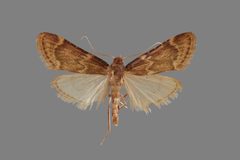
Aglossa cacamica is a snout moth in the Pyralidae, described by Harrison Gray Dyar Jr. in 1913–1914. It is native to North America, with confirmed records from California. The has a wingspan of 22–34 mm. It belongs to a whose derives from the elongated labial palps that form a snout-like projection.
Pronunciation
How to pronounce Aglossa cacamica: /æˈɡlɒsə kəˈkæmɪkə/
These audio files are automatically generated. While they are not always 100% accurate, they are a good starting point.
Identification
Distinguished from other Aglossa by geographic distribution (western North America, particularly California) and potentially by genitalia , though specific diagnostic features are not detailed in accessible literature. The can be recognized by the prominent snout formed by elongated labial palps. Accurate identification to species level likely requires examination of genitalia or molecular analysis.
Images
Appearance
Medium-sized pyralid with wingspan 22–34 mm. As a member of the Aglossa, it possesses elongated labial palps that project forward from the , creating the characteristic 'snout' appearance. Wing pattern and coloration details are not well documented in available sources.
Distribution
North America, with confirmed occurrence in California. Specific preferences within this range are not documented.
Similar Taxa
- Other Aglossa speciesMembers of the Aglossa share the distinctive snout-like labial palps and similar overall body plan; A. cacamica is distinguished by its western North American distribution and was described specifically from California material
More Details
Authorship date discrepancy
Sources vary between 1913 (Wikipedia, iNaturalist) and 1914 (Catalogue of Life, GBIF, NCBI) for the original description date. This likely reflects variation in publication date versus actual printing/distribution date of the original description.
Etymology
The specific epithet 'cacamica' is unusual and its derivation is not documented in available sources; it does not appear to follow standard Latin or Greek roots commonly used in lepidopteran .