
Psorosina hammondi
Riley, 1872
Appleleaf Skeletonizer
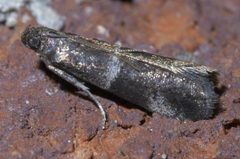
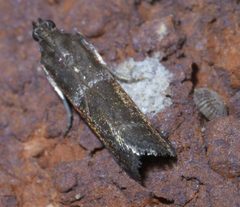
Psorosina hammondi is a pyralid in the Phycitinae, commonly known as the Appleleaf Skeletonizer. The was described by Riley in 1872 and is notable for its specialized larval feeding on hawthorn (Crataegus) leaves, producing characteristic skeletonizing damage. Despite its distinctive and association, detailed biological information remains limited in accessible literature.
Pronunciation
How to pronounce Psorosina hammondi: /psoʊˈrɔːsɪnə ˈhæməndi/
These audio files are automatically generated. While they are not always 100% accurate, they are a good starting point.
Identification
The is most readily identified by its association with Crataegus (hawthorn) and the distinctive skeletonizing feeding damage produced by its larvae. may be attracted to lights. Specific morphological characters distinguishing P. hammondi from other Phycitinae species are not documented in the available sources.
Images
Appearance
As a pyralid , likely possess the typical characteristics including scaled wings, a slender body, and thread-like or slightly feathered . The "Appleleaf Skeletonizer" suggests larvae are the more conspicuous life stage, though specific morphological descriptions of either larvae or adults are not readily available in the provided sources.
Diet
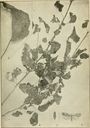
Larvae feed on Crataegus (hawthorn) leaves, consuming tissue between the leaf and producing characteristic skeletonizing damage.
Host Associations
- Crataegus - larval food planthawthorn
Behavior
Larvae exhibit skeletonizing feeding , consuming leaf tissue between while leaving the vascular network intact. This produces a characteristic lace-like appearance on damaged leaves.
Human Relevance
The "Appleleaf Skeletonizer" suggests potential relevance to apple , though the primary documented is hawthorn (Crataegus). The may be of minor concern as a foliar pest.
Similar Taxa
- Other Phycitinae speciesMany pyralid moths share similar ; accurate identification requires examination of genitalia or association with specific plants and larval feeding damage patterns.
More Details
Taxonomic History
Described by Riley in 1872, this has received limited modern study. The specific epithet 'hammondi' likely honors an individual, though the namesake is not documented in the available sources.
Research Gaps
Significant gaps exist in knowledge of this ' , geographic range, , and detailed . The single accessible source provides only association and feeding damage information from the abstract of a 1974 study.
Sources and further reading
- BugGuide
- GBIF taxonomy match
- iNaturalist taxon
- Catalogue of Life
- New, possibly arboreal rice rat species discovered in Ecuador
- Super duper June bugs | Beetles In The Bush
- biodiversity | Blog - Part 20
- new species | Blog - Part 14
- The Biology of the Appleleaf Skeletonizer, Psorosina hammondi, on Crataegus (Lepidoptera: Pyralidae: Phycitinae)1, 2