
Pima boisduvaliella
Guenée, 1845
Silver-edged Knot-horn
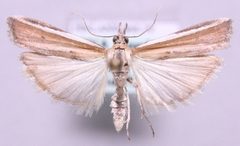
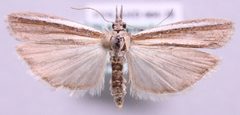
Pima boisduvaliella is a of snout moth in the Pyralidae, commonly known as the Silver-edged Knot-horn. It has a broad distribution spanning most of Europe, parts of Asia, and northern North America. The species is notable for its larval feeding inside the pods of leguminous plants.
Pronunciation
How to pronounce Pima boisduvaliella: /ˈpiːmə ˌbwaɪsduːvæliˈɛlə/
These audio files are automatically generated. While they are not always 100% accurate, they are a good starting point.
Identification
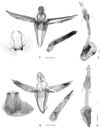
The combination of small size (wingspan 22–26 mm), snout moth characteristics, and association with legume pods distinguishes this from similar pyralids. The specific epithet and reference the silver-edged wing pattern, which may aid in field identification. Accurate identification may require examination of genitalia or molecular methods.
Images
Habitat
The occupies diverse across its wide geographic range, including grasslands, meadows, and other areas where its leguminous plants grow. Larval development occurs specifically within the pods of host plants, indicating a close association with flowering legume vegetation.
Distribution
Most of Europe (absent from Ireland, Czech Republic, Slovakia, Ukraine, and most of the Balkan Peninsula); Asia including Mongolia and Kazakhstan; northern North America including Alberta, Canada. The disjunct distribution across three continents suggests either human-mediated or relictual .
Seasonality
are active from June to August. The period corresponds with the flowering and pod development of its plants. Larval development occurs within host pods, with timing dependent on host plant .
Diet
Larvae feed inside the pods of leguminous plants including Anthyllis, Lotus (including Lotus corniculatus), Ononis, Astragalus, and Lathyrus maritimus. feeding habits are not documented.
Host Associations
- Anthyllis - larval larvae feed inside pods
- Lotus - larval including Lotus corniculatus; larvae feed inside pods
- Ononis - larval larvae feed inside pods
- Astragalus - larval larvae feed inside pods
- Lathyrus maritimus - larval larvae feed inside pods
Life Cycle
The involves larval development inside legume pods, where feeding occurs on the seeds or pod contents. likely occurs within the pod or in the soil. emerge in summer (June–August). The likely has one per year in most of its range, though this has not been explicitly documented.
Behavior
Larvae exhibit specialized feeding , consuming plant material from within the protective enclosure of legume pods. This endophytic feeding strategy provides shelter from and environmental conditions. behavior is poorly documented.
Ecological Role
As a seed of leguminous plants, larvae may influence plant reproductive success and . The contributes to complexity as prey for and other natural enemies, though specific parasitoid associations are not documented.
Human Relevance
The has limited direct economic impact. It is not considered a major agricultural pest, though localized damage to forage legumes may occur. It contributes to biodiversity in grassland and meadow and serves as a subject for entomological study due to its wide distribution and specialized associations.
Similar Taxa
- Other Pima speciesCongeneric may share similar and associations; accurate identification requires detailed examination
- Other Phycitinae members often share legume-feeding habits and similar size; genitalia examination typically required for definitive identification
More Details
Taxonomic history
Originally described as Epischnia boisduvaliella by Guenée in 1845, later transferred to Pima. The specific epithet honors Jean-Baptiste Boisduval, a prominent French entomologist.
Conservation status
Not evaluated by IUCN; appears to be widespread and relatively common across its range with no documented threats.