
Melitara subumbrella
(Dyar, 1925)
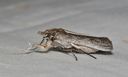
Melitara subumbrella is a snout moth (Pyralidae: Phycitinae) described by Dyar in 1925. It is widespread in western North America, where larvae are herbivores of prickly pear cactus (Opuntia). The species is notable as the of a recently described gregarious , Iconella melitaraevora, which has potential applications.

Pronunciation
How to pronounce Melitara subumbrella: /mɛlɪˈtɑrə sʌbʌmˈbrɛlə/
These audio files are automatically generated. While they are not always 100% accurate, they are a good starting point.
Identification
active March–May, with possible second October–November in some locations. Distinguished from related cactus-feeding Melitara by geographic range and, in larvae, by the combination of white ground color with light purple cross-bands. Association with Opuntia plants provides additional diagnostic context.
Images
Habitat
Montane dryland and mid-elevation montane woodlands, including Piñon-Juniper vegetation. Larvae develop within tunnels excavated inside prickly pear cactus pads.
Distribution
Western North America: southern Alberta and Saskatchewan (Canada) south through central Texas, southern New Mexico, southern Arizona, and southeastern California (USA). Documented in Santa Fe County, New Mexico.
Seasonality
on wing March to May. Second may occur in some locations with adults active October to November.
Diet
Larvae feed on multiple Opuntia : Opuntia basilaris, Opuntia ficus-indica, Opuntia macrorhiza var. macrorhiza, Opuntia atrispina, Opuntia phaeacantha, Opuntia polyacantha, and Opuntia violaceae var. macrocentra.
Host Associations
- Opuntia basilaris - larval food plant
- Opuntia ficus-indica - larval food plant
- Opuntia macrorhiza var. macrorhiza - larval food plant
- Opuntia atrispina - larval food plant
- Opuntia phaeacantha - larval food plant
- Opuntia polyacantha - larval food plant
- Opuntia violaceae var. macrocentra - larval food plant
- Iconella melitaraevora - gregarious braconid ; emerges from ultimate instar larvae
Life Cycle
Larvae excavate tunnels within cactus pads for development. They construct silk-covered holes to exude and build silken within the host plant. occurs inside the host. Ultimate instar larvae are parasitized by the gregarious Iconella melitaraevora, which emerges to spin cocoons and pupate externally.
Behavior
Larvae construct silk-covered holes in cactus to expel from interior tunnels. They excavate extensive tunnel systems within cactus pads and build silken for . Gregarious emerge from parasitized larvae.
Ecological Role
herbivore of prickly pear cactus; serves as for including Iconella melitaraevora. The parasitoid has been discussed for potential of cactus-feeding herbivores.
Human Relevance
Potential target via its Iconella melitaraevora, which may be useful for managing cactus-feeding pest . No direct agricultural or economic significance of M. subumbrella itself has been documented.
Similar Taxa
- Other Melitara speciesMultiple Melitara are cactus-feeding ; M. subumbrella is distinguished by geographic distribution (western North America), (March–May, possible second October–November), and larval coloration (white with light purple cross-bands). Specific plant associations and molecular data may be required for definitive identification.
More Details
Parasitoid biology
Iconella melitaraevora is the first documented case of gregariousness in the Iconella. Multiple cohorts were reared from collected in New Mexico, indicating successful across larval development.
Sources and further reading
- BugGuide
- Wikipedia
- GBIF taxonomy match
- iNaturalist taxon
- NCBI Taxonomy
- A new species of Iconella (Mason, 1981) (Hymenoptera, Braconidae, Microgastrinae), a parasitoid of Melitara subumbrella (Dyar, 1925) cactus moth larvae from New Mexico with biological notes and an updated key to the American Iconella species
- Figure 2 from: Morrison CR, Armstrong WR, Plowes RM, Gilbert LE, Fernández-Triana JL (2025) A new species of Iconella (Mason, 1981) (Hymenoptera, Braconidae, Microgastrinae), a parasitoid of Melitara subumbrella (Dyar, 1925) cactus moth larvae from New Mexico with biological notes and an updated key to the American Iconella species. Journal of Hymenoptera Research 98: 483-498. https://doi.org/10.3897/jhr.98.151036
- Figure 3 from: Morrison CR, Armstrong WR, Plowes RM, Gilbert LE, Fernández-Triana JL (2025) A new species of Iconella (Mason, 1981) (Hymenoptera, Braconidae, Microgastrinae), a parasitoid of Melitara subumbrella (Dyar, 1925) cactus moth larvae from New Mexico with biological notes and an updated key to the American Iconella species. Journal of Hymenoptera Research 98: 483-498. https://doi.org/10.3897/jhr.98.151036
- Figure 1 from: Morrison CR, Armstrong WR, Plowes RM, Gilbert LE, Fernández-Triana JL (2025) A new species of Iconella (Mason, 1981) (Hymenoptera, Braconidae, Microgastrinae), a parasitoid of Melitara subumbrella (Dyar, 1925) cactus moth larvae from New Mexico with biological notes and an updated key to the American Iconella species. Journal of Hymenoptera Research 98: 483-498. https://doi.org/10.3897/jhr.98.151036
- Supplementary material 1 from: Morrison CR, Armstrong WR, Plowes RM, Gilbert LE, Fernández-Triana JL (2025) A new species of Iconella (Mason, 1981) (Hymenoptera, Braconidae, Microgastrinae), a parasitoid of Melitara subumbrella (Dyar, 1925) cactus moth larvae from New Mexico with biological notes and an updated key to the American Iconella species. Journal of Hymenoptera Research 98: 483-498. https://doi.org/10.3897/jhr.98.151036