
Macalla zelleri
Grote, 1876
Zeller's Macalla Moth, Zeller's epipaschia moth
Macalla zelleri is a snout moth in the Pyralidae, first described by Augustus Radcliffe Grote in 1876. The is notable for having caterpillars that feed on poison ivy (Toxicodendron radicans), potentially offering a for this problematic plant. are found across eastern and central North America, with records spanning from southern Canada to the southwestern United States.
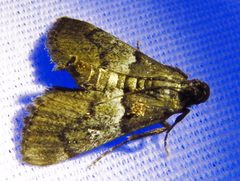
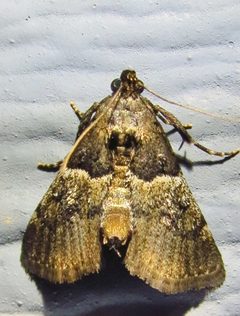
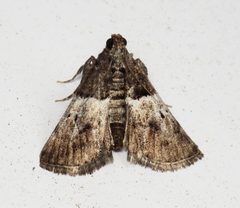
Pronunciation
How to pronounce Macalla zelleri: /məˈkælə ˈzɛləri/
These audio files are automatically generated. While they are not always 100% accurate, they are a good starting point.
Images
Distribution
Found from Ontario and New Jersey south to Florida, and westward to Arizona and Minnesota. The occupies a broad range across eastern and central North America.
Diet
Larvae feed on poison ivy (Toxicodendron radicans, formerly Rhus radicans). feeding habits are not documented in available sources.
Host Associations
- Toxicodendron radicans - larval food plantpoison ivy; larvae have yellow bodies with light red bearing pale freckles
Life Cycle
Larval stage has been described: yellow body with light red and pale freckles. Complete details including and timing are not documented.
Ecological Role
Larvae may provide limited of poison ivy, a plant that causes contact dermatitis in humans and can dominate disturbed .
Human Relevance
The larval plant relationship with poison ivy is of potential interest for natural management of this noxious weed, though the is not widely utilized for this purpose.
Similar Taxa
- Epipaschia superatalisBoth belong to Epipaschiinae and share similar overall ; E. superatalis is known as the Dimorphic Macalla Moth
More Details
Taxonomic note
The epithet 'zelleri' honors German entomologist Philipp Christoph Zeller (1808-1883), a prominent in Microlepidoptera.
Observation frequency
As of 2024, the has over 1,100 observations on iNaturalist, indicating it is encountered with moderate frequency by naturalists.