
Duponchelia fovealis
Zeller, 1847
European Pepper Moth
Duponchelia fovealis is a small in the Crambidae, originally described from the Mediterranean region in 1847. It has undergone substantial range expansion and is now established across Europe, Africa, the Middle East, and the Americas. The is a significant agricultural pest, particularly in protected strawberry , where larval feeding causes damage to leaves and fruits. Its nature and potential have made it a focus of research, especially regarding with Trichogramma .
Pronunciation
How to pronounce Duponchelia fovealis: //djuːpɒnˈkeɪliə ˌfoʊviˈælɪs//
These audio files are automatically generated. While they are not always 100% accurate, they are a good starting point.
Identification
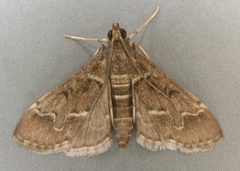
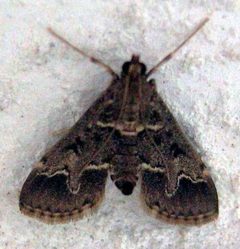
are small with a wingspan of about 20 mm. Distinguishing D. fovealis from similar crambid moths requires examination of genitalia or molecular identification; visual identification based on size alone is unreliable. traps baited with -specific lures are used for detection and monitoring in agricultural settings.
Images
Habitat
Primarily associated with agricultural environments, especially protected systems such as greenhouses and low tunnels for strawberry production. Has been detected in ornamental plant production facilities. Native presumably Mediterranean coastal and associated terrestrial environments, though specific natural habitat requirements are not documented.
Distribution
Native to the Mediterranean Sea region and Canary Islands. Established across Europe (including Scandinavia, UK, and Mediterranean countries), North Africa, sub-Saharan Africa, the Middle East, and South Asia. Introduced to North America with confirmed presence in at least 13 U.S. states, Canada (Ontario), Mexico, and Central America ( Rica). Present in South America, notably Brazil where it is a key strawberry pest.
Seasonality
period recorded from May to June in native range, though timing varies by location. In invaded regions, activity patterns correspond with crop production cycles in protected . Multiple per year likely occur in favorable conditions, though specific voltinism not documented in sources.
Diet
larval feeder. Documented include at least 47 plant . Confirmed hosts from empirical studies: strawberry (Fragaria × ananassa), pepper, tomato, cucumber, corn, pomegranate, and numerous ornamental including Anemone, Anthurium, Begonia, Cyclamen, Euphorbia, Gerbera, Kalanchoe, Limonium, and Rosa. Laboratory feeding assays show differential consumption across plant groups, with tropical house plants least preferred and certain herbaceous and woody ornamental species highly consumed.
Host Associations
- Fragaria × ananassa - larval key crop , causes severe damage to leaves and fruits
- Capsicum - larval peppers
- Solanum lycopersicum - larval tomato
- Cucumis sativus - larval cucumber
- Zea mays - larval corn
- Punica granatum - larval pomegranate
- Rosa - larval rose
- Anemone - larval ornamental
- Anthurium - larval ornamental
- Begonia - larval ornamental
- Cyclamen - larval ornamental
- Euphorbia - larval ornamental
- Gerbera - larval ornamental
- Kalanchoe - larval ornamental
- Limonium - larval ornamental
Life Cycle
Complete with , larval, pupal, and stages. Eggs are laid on plants and are parasitized by Trichogramma in programs. Larval stage is the damaging feeding stage. Specific developmental durations, stage, and times not documented in provided sources.
Behavior
are attracted to female-produced , which are exploited for monitoring and detection. Larvae feed on plant tissues, with feeding damage concentrated on leaves and fruits of plants. activity pattern presumed based on characteristics, though not explicitly documented.
Ecological Role
Herbivore in agricultural . Serves as for in the Trichogrammatidae, including Trichogramma galloi, T. pretiosum, T. atopovirilia, and T. exiguum. No documented role in natural ecosystems; appears to function primarily as a pest in anthropogenic environments.
Human Relevance
Major agricultural pest, particularly in strawberry production where it causes substantial economic damage. Subject to and regulatory attention in North America following detection in 2005. Management relies on combining monitoring with traps, with Trichogramma , and selective applications. and insecticides have been evaluated for compatibility with biological control agents. Recommended release rate for T. pretiosum biological control: 93,000 females per hectare every three days.
Similar Taxa
- Other Spilomelinae speciesSimilar small size and general crambid ; requires genitalia examination or molecular methods for reliable identification
- Other Duponchelia speciesCongeneric may overlap in distribution and require taxonomic examination to distinguish
More Details
Invasion History
First North American detection in 2005 in California begonia shipment, followed by greenhouse detections in Ontario, Canada same year. By November 2010, confirmed in at least 13 U.S. states. Spread facilitated by trade in ornamental plants.
Biological Control Research
Extensively studied as target for Trichogramma . Research shows T. pretiosum has effective capacity of 14.21 linear meters in strawberry tunnel systems, with optimal parasitoid-to-egg ratios of 4-8:1 for T. galloi and T. pretiosum. Compatibility demonstrated between bassiana fungi and Trichogramma for combined use.
Genome Resources
sequence published, available as resource for further research (Wellcome Open Research, 2024).
Sources and further reading
- BugGuide
- Wikipedia
- GBIF taxonomy match
- iNaturalist taxon
- NCBI Taxonomy
- Catalogue of Life
- Duponchelia fovealis . [Distribution map].
- Duponchelia fovealis Zeller. [Distribution map].
- Detección con feromonas de Duponchelia fovealis Zeller en fincas freseras de Costa Rica Detection of Duponchelia fovealis Zeller with pheromones in strawberry farms of Costa Rica
- Dispersal Capacity of Trichogramma for the Management of Duponchelia fovealis
- Differential feeding on ornamental plants by Duponchelia fovealis (Lepidoptera: Crambidae) larvae
- Seletividade de inseticidas reguladores de crescimento e botânico no parasitismo de três espécies de Trichogramma em ovos de Duponchelia fovealis Zeller (Lepidoptera: Crambidae)
- Functional Response of Two Egg Parasitoids of Trichogramma (Hymenoptera: Trichogrammatidae) Genre on Duponchelia fovealis Zeller (Lepidoptera: Crambidae) Eggs
- Duponchelia fovealis (Lepidoptera: Crambidae) and its Parasitoid in Cultivated Berries in Guanajuato, Mexico
- Trichogramma galloi and Trichogramma pretiosum for the management of Duponchelia fovealis (Lepidoptera: Crambidae) in strawberry plants
- Compatibility between Entomopathogenic Fungi and Egg Parasitoids (Trichogrammatidae): A Laboratory Study for Their Combined Use to Control Duponchelia fovealis
- The genome sequence of the European Pepper moth, Duponchelia fovealis (Zeller, 1847) (Lepidoptera: Crambidae).