
Ategumia ebulealis
(Guenée, 1854)
Clidemia Leafroller
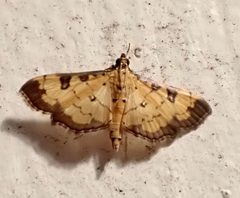
Ategumia ebulealis, the Clidemia Leafroller, is a small crambid with a wingspan of approximately 18 mm. The occurs in the southeastern United States, Central America, and the Caribbean. are active during multiple periods throughout the year in Florida. The larvae feed on specific plants including Clidemia species and Heterotrichum umbellatum.
Pronunciation
How to pronounce Ategumia ebulealis: /ˌætɪˈɡuːmiə ˌɛbjuːliˈeɪlɪs/
These audio files are automatically generated. While they are not always 100% accurate, they are a good starting point.
Identification
Distinguished from the Ategumia matutinalis, which was previously confused with this in Hawaii. Accurate identification requires examination of genitalia or molecular analysis; the two species cannot be reliably separated by external alone.
Images
Habitat
Associated with plants Clidemia and Heterotrichum umbellatum. Specific type beyond host plant presence is not documented.
Distribution
Southeastern United States (Florida and Georgia), Central America, the Antilles. Records from Hawaii represent misidentifications of Ategumia matutinalis.
Seasonality
active in Florida during January, March to April, and June to December. Seasonality in other parts of the range is not documented.
Diet
Larvae feed on Heterotrichum umbellatum and Clidemia , including C. hirta. feeding habits are not documented.
Host Associations
- Clidemia hirta - larval
- Clidemia - larval -level association
- Heterotrichum umbellatum - larval
Behavior
Larvae are leafrollers, creating shelters by rolling or tying leaves of plants.
Ecological Role
Herbivore; larval feeding on Clidemia may contribute to of this plant , which includes species considered in some regions.
Human Relevance
Was considered for of Clidemia hirta in Hawaii, but the released was subsequently identified as Ategumia matutinalis rather than A. ebulealis.
Similar Taxa
- Ategumia matutinalisMorphologically similar; previously confused with A. ebulealis in Hawaii. Requires genitalia examination or molecular methods for reliable separation.
Misconceptions
Long thought to have been introduced to Hawaii for , but later research determined the released was actually Ategumia matutinalis.