
Omiodes indicata
Fabricius, 1775
bean-leaf webworm moth, soybean leaf folder
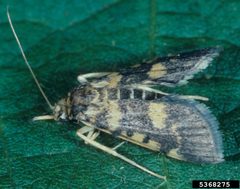
Omiodes indicata is a small crambid with a wingspan of approximately 20 mm. It is a significant agricultural pest of leguminous crops across tropical and subtropical regions of Asia, Africa, and the Americas. The is multivoltine with overlapping , causing damage throughout the year.


Pronunciation
How to pronounce Omiodes indicata: /oʊˈmaɪədiːz ˌɪndɪˈkeɪtə/
These audio files are automatically generated. While they are not always 100% accurate, they are a good starting point.
Images
Habitat
Tropical and subtropical regions. Laboratory colonies maintained at 26±1°C, 14L:10D , 75±5% relative humidity.
Distribution
Florida to Texas, West Indies, Mexico to South America, Cameroon, Comoros, Democratic Republic of Congo, La Réunion, Madagascar, Mauritius, Nigeria, Saudi Arabia, Seychelles, South Africa, India, Borneo, Australia (Queensland), and China (Guizhou).
Seasonality
Active year-round; severe occur during vegetative and reproductive stages of crops.
Diet
Fresh soybean plants (Glycine max). feed on 15% (w/v) honey solution in laboratory settings.
Host Associations
- Glycine max - primary soybean
- Vigna mungo - black gram
- Phaseolus vulgaris - common bean
- Vigna radiata - mung bean
- Vigna unguiculata - cowpea
- Lablab purpureus - lablab bean
Life Cycle
Multivoltine with overlapping . Entire larval stage spent concealed within leaf folds. occurs inside rolled leaves. emerge from pupae.
Behavior
Larvae use silk to bind leaves together, constructing protective webbed shelters inside which they feed. This cryptic feeding habit within leaf rolls reduces effectiveness of chemical control.
Ecological Role
Major pest constraint to legume production. Larval feeding causes skeletonization of leaves, reduced photosynthetic capacity, and adverse effects on pod development and yield.
Human Relevance
of 8-9 rolled leaves per plant warrants chemical intervention. Significant impacts on food security in affected regions.