
Omiodes
Guenée, 1854
Species Guides
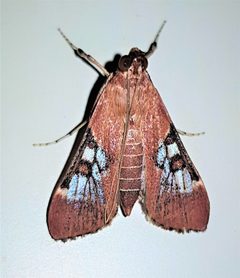
4- Omiodes indicata(bean-leaf webworm moth)
- Omiodes martyralis
- Omiodes simialis
- Omiodes stigmosalis
Omiodes is a of in the Crambidae ( Spilomelinae) containing approximately 90 described . Several species are to Hawaii, where they are known by Hawaiian such as hedyleptan moths. The genus includes significant agricultural pests, notably Omiodes indicata, a pest of leguminous crops in tropical and subtropical regions. Other species such as Omiodes blackburni (coconut leafroller) and Omiodes demaratalis (Hawaiian grass leafroller) have documented economic impacts.


Pronunciation
How to pronounce Omiodes: /oʊ.miˈoʊ.diz/
These audio files are automatically generated. While they are not always 100% accurate, they are a good starting point.
Images
Distribution
occur in tropical and subtropical regions across Asia, Africa, and the Americas. Several species are to Hawaii. Specific documented localities include Guiyang, China (26°23′49.538″N, 106°40′31.616″E) for O. indicata, and Mandla, Madhya Pradesh, India for O. milvinalis.
Human Relevance
Several are agricultural pests of economic significance. Omiodes indicata is a major pest of leguminous crops including soybean, black gram, common bean, mung bean, cowpea, and lablab bean, causing damage through larval leaf rolling and feeding that reduces photosynthetic capacity and pod development. Omiodes blackburni, known as the coconut leafroller, and Omiodes demaratalis, the Hawaiian grass leafroller, are additional species with documented economic impacts. The for chemical intervention in O. indicata has been established at 8-9 rolled leaves per plant.
More Details
Genome Resources
A chromosomal-level assembly has been published for Omiodes indicata, comprising 493.08 Mb across 31 , with 14,713 protein-coding genes and 38.13% repetitive elements.