
Lineodes integra
Zeller, 1873
Eggplant Leafroller Moth, Nightshade Leaftier
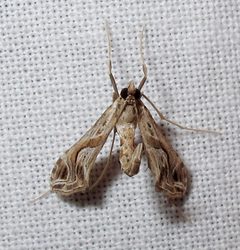
Lineodes integra is a small in the Crambidae, commonly known as the eggplant leafroller moth or nightshade leaftier. The is native to the Americas, with a broad distribution from the southern United States through Central America to South America. It is recognized as a pest of cultivated Solanaceae crops, with larvae that feed on leaves and developing fruit. The species was first described by Zeller in 1873.


Pronunciation
How to pronounce Lineodes integra: /lɪniːoʊdiːz ɪnˈteɪɡrə/
These audio files are automatically generated. While they are not always 100% accurate, they are a good starting point.
Identification
Images
Habitat
Agricultural and natural environments where Solanaceae plants occur. Has been recorded in cultivated fields, gardens, and presumably native vegetation supporting wild Solanaceae .
Distribution
Native to the Americas. Found from the southern United States (Florida to California) south to Chile. Additional records from Illinois, Michigan, Ontario (Canada), and Cuba indicate occasional northward or established in temperate regions.
Diet
Larvae feed on Solanaceae , including: Solanum melongena (eggplant), Solanum lycopersicum (tomato), Solanum viarum (tropical soda apple), Capsicum species (peppers), and Physalis species (groundcherries). feeding habits are not documented.
Host Associations
- Solanum melongena - larval food planteggplant
- Solanum lycopersicum - larval food planttomato
- Solanum viarum - larval food planttropical soda apple
- Capsicum - larval food plantpepper
- Physalis - larval food plantgroundcherry
Behavior
Larval includes leaf rolling or tying, as indicated by . Specific details on behavior, mating, or oviposition have not been documented in available sources.
Ecological Role
Herbivore specializing on Solanaceae. In agricultural systems, functions as a crop pest. Ecological role in native is not documented.
Human Relevance
Recognized agricultural pest of eggplant, tomato, and pepper crops. Larval feeding damages leaves and may affect fruit development. Management in commercial agriculture may involve practices.
Similar Taxa
More Details
Taxonomic History
First described by Philipp Christoph Zeller in 1873. The has been variously referred to by emphasizing its larval habit of rolling or tying leaves of nightshade plants.
Observation Frequency
As of source date, iNaturalist records 4,381 observations, indicating the is relatively frequently encountered within its range, likely due to its association with common agricultural crops.
Sources and further reading
- BugGuide
- Wikipedia
- GBIF taxonomy match
- iNaturalist taxon
- NCBI Taxonomy
- Catalogue of Life
- Pensoft Publishers integrate their journal platform with OpenAIRE | Blog
- People Matter: Why the Human Factor Is Essential for Successful Integrated Pest Management Programs
- A genus of European paper wasps revised for the first time using integrative taxonomy | Blog
- Integrated Mosquito Management Protects People and Animals From Mosquitoes
- Whatever Happened to People in Integrated Pest Management?
- The Current State of Integrated Tick Management