
Herpetogramma bipunctalis
Fabricius, 1794
southern beet webworm moth, two-spotted herpetogramma
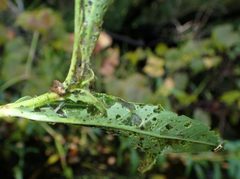
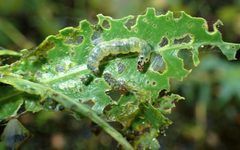
Herpetogramma bipunctalis is a crambid commonly known as the southern beet webworm moth. The is distributed across the Americas, from the eastern and central United States through Central America, the Caribbean, and into South America. Larvae are leaf-feeders that develop through five instars, with mature larvae reaching 3–4 cm in length. The species has been documented on multiple plants including blackberry (Rubus spp.) and Solanum trilobatum, and has been successfully reared in laboratory conditions.
Pronunciation
How to pronounce Herpetogramma bipunctalis: /hɛrpɛtoʊˈɡræmə baɪpʌŋkˈteɪlɪs/
These audio files are automatically generated. While they are not always 100% accurate, they are a good starting point.
Identification
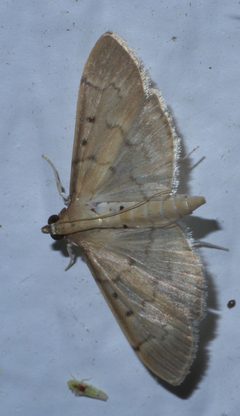
can be recognized by the combination of small size (23–24 mm wingspan), creamy brown wings with wavy and discoidal spotting patterns, and two dark spots on the . Larvae are distinguished by green coloration with dark , five instars, and the presence of subventral setae trisetose on the first abdominal segment with D and SD pinacula of the . The obtect pupa with seven spiral is characteristic. Similar Herpetogramma may require examination of genitalia or detailed wing pattern analysis for definitive separation.
Images
Habitat
Associated with agricultural and wild plants; larvae feed on leaves of various plant . Rearing studies indicate adaptability to blackberry systems. Specific natural preferences not well documented.
Distribution
North America: New England to Florida, west to Texas and north to Illinois. Central and South America: extends through Central America and the Caribbean to South America. Also recorded from Galápagos Islands and Democratic Republic of the Congo (Bas Congo, Equateur, Katanga provinces).
Diet
Larval feeding on leaves of multiple plant . Documented include blackberry (Rubus spp., Rosaceae) and Solanum trilobatum (Solanaceae). Specific feeding habits not described in available sources.
Host Associations
- Rubus spp. - larval food plantblackberry, Rosaceae
- Solanum trilobatum - larval food plantnew record, Solanaceae
Life Cycle
Holometabolous development. stage: 4–5 days (Wikipedia source) or 3.75 days (Indian study). Five larval instars: total larval period 17–26 days depending on plant and conditions. Pupal stage: 6–13 days, pupa formed in leaf folds or soil debris. Total egg-to- development: 23–39 days (Wikipedia) or 32–45 days (studies). Females lay mean of 252 eggs over approximately 14 days with 2–3 day pre-oviposition period. time permits multiple generations per year in favorable climates.
Behavior
Larvae of later instars observed in large groups. and early instar larvae feed on leaf surfaces; later instars may create exit holes in stems to reach soil for . not described as or in available sources.
Ecological Role
Herbivorous larval stage contributes to leaf damage on plants. influenced by host plant quality, with development time varying between cultivars (e.g., shorter on Guarani vs. Xavante blackberry cultivars). Potential pest status in blackberry based on laboratory rearing success.
Human Relevance
Documented as a pest of blackberry (Rubus spp.) in Brazilian agriculture, with laboratory rearing protocols developed for management studies. Potential economic significance in berry where densities are high. No other documented human interactions in available sources.
Similar Taxa
- Herpetogramma phaeopteralisSimilar generic appearance in Crambidae; distinguished by specific wing pattern details and geographic distribution
- Other Spilomelinae speciesRequire examination of genitalia or detailed morphological analysis for definitive identification; superficial similarity in body form and wing shape
More Details
Developmental Variation
Development time varies significantly with plant and rearing conditions. Studies report -to- periods ranging from 23–39 days to 32–45 days, with larval periods of 17–26 days. Blackberry cultivar affects development rate.
Laboratory Rearing
Successful protocols developed using blackberry leaves on paper towel substrates, with survival to adulthood of approximately 33% under laboratory conditions. Sex ratio approximately 1:1 (0.51 female proportion).
Taxonomic Note
Larval chaetotaxy provides diagnostic characters: subventral setae trisetose on first abdominal segment and D and SD pinacula of are characteristic of H. bipunctalis.
Sources and further reading
- BugGuide
- Wikipedia
- GBIF taxonomy match
- iNaturalist taxon
- NCBI Taxonomy
- Catalogue of Life
- Noctuidae | Beetles In The Bush | Page 3
- Biology of Herpetogramma bipunctalis (Fabricius) with descriptions of larval chaetotaxy
- Herpetogramma bipunctalis (Lepidoptera: Crambidae) biology and techniques for rearing on leaves of the blackberry (Rubus spp., Rosaceae)