
Eurrhyparodes splendens
Druce, 1895
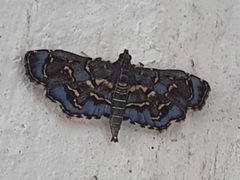
Eurrhyparodes splendens is a small crambid described by Herbert Druce in 1895. It is distinguished by striking metallic steel-blue bands bordering the wing margins and yellowish-white transverse lines on both forewings and hindwings. The occurs from the southwestern United States through Mexico to Central America. have been recorded active in July, September, and December.
Pronunciation
How to pronounce Eurrhyparodes splendens: //jʊˌrɪpəˈroʊdiːz ˈsplɛnˌdɛnz//
These audio files are automatically generated. While they are not always 100% accurate, they are a good starting point.
Identification
The combination of small size (~19 mm wingspan), dark brown ground color, three yellowish-white waved lines on forewings, and distinctive metallic steel-blue bands on wing margins separates this from and other small crambids. The hindwing pattern with two straight and one waved yellowish-white line plus matching metallic marginal borders provides additional diagnostic characters.
Images
Appearance
Small with wingspan approximately 19 mm. Forewings dark brown with three fine waved yellowish-white transverse lines; third line, outer margin, and part of inner margin bordered by metallic steel-blue band. Hindwings with two yellowish-white lines running from costal to inner margin and a third waved line; both outer and inner margins bordered with metallic steel blue.
Distribution
United States (Arizona, Texas); Mexico (Xalapa, Veracruz, Morelos, Guerrero, Yucatán); Guatemala; Rica.
Seasonality
recorded on wing in July, September, and December.
Similar Taxa
- Other Eurrhyparodes species share general wing pattern elements but differ in specific arrangement and presence of metallic marginal bands; E. splendens is distinguished by the particular configuration of three forewing lines and two straight plus one waved hindwing line combined with extensive steel-blue marginal borders.
- Other Spilomelinae with metallic markingsSeveral spilomeline crambids exhibit metallic wing markings, but the specific pattern of yellowish-white transverse lines paired with steel-blue marginal bands on both wing pairs is characteristic of E. splendens.
More Details
Original Description
First described by British entomologist Herbert Druce in 1895 based on specimens from the stated range.
Observation Frequency
As of source data compilation, 148 observations recorded on iNaturalist, indicating moderate detectability within its range.