
Hahncappsia marculenta
Grote & Robinson, 1867
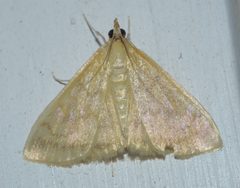
Hahncappsia marculenta is a crambid described by Grote and Robinson in 1867. It is widespread in eastern North America, occurring from the Great Plains to the Atlantic coast. The exhibits in size, with females larger than males. are active from late spring through early fall.

Pronunciation
How to pronounce Hahncappsia marculenta: /hɑnˈkæpsiə mɑrˈkuːləntə/
These audio files are automatically generated. While they are not always 100% accurate, they are a good starting point.
Identification
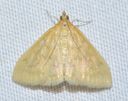
Pale yellow forewings with luteous (muddy-yellow) markings; hindwings paler yellow. Males have wingspan 18–24 mm, females 21–26 mm. The combination of pale yellow ground color with darker luteous markings distinguishes it from similar yellow crambid in the .
Images
Distribution
Eastern North America, widespread east of the Rocky Mountains. Documented in Vermont and other eastern US states.
Seasonality
recorded on wing from May to September.
Diet
Larvae feed on Ambrosia trifida (giant ragweed) and Solidago (goldenrods).