
Noctueliopsis bububattalis
Hulst, 1886
Tawny Bantam
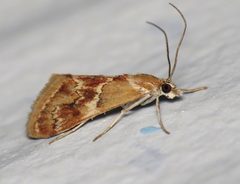
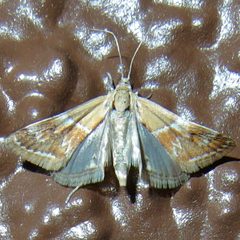
Noctueliopsis bububattalis is a small crambid native to southwestern North America. It was first described by George Duryea Hulst in 1886. are active in early spring and can be recognized by their distinctive dark maroon-brown forewings with white transverse lines. The is commonly known as the Tawny Bantam.
Pronunciation
How to pronounce Noctueliopsis bububattalis: /nɔkˌtʊ.ɛ.liˈɒp.sɪs ˌbuː.buˈbæt.lɪs/
These audio files are automatically generated. While they are not always 100% accurate, they are a good starting point.
Identification
The combination of small size (17 mm wingspan), dark maroon-brown forewings with two white transverse lines, and two small spots before the middle of the forewing distinguishes this from other Noctueliopsis. The dark fuscous hindwings without pattern provide additional contrast with the marked forewings.
Images
Appearance
A small with a wingspan of approximately 17 mm. Forewings are dark maroon brown with two white transverse lines—one positioned just within the middle of the wing and another at the margin. Two small spots are present just before the middle of the forewing. Hindwings are uniformly dark fuscous.
Distribution
Recorded from Arizona, California, Colorado, New Mexico, Texas, and Utah in southwestern and western North America.
Seasonality
are on wing from February to May, with peak activity in early spring.
Similar Taxa
- Other Noctueliopsis speciesSimilar small size and general crambid , but N. bububattalis is distinguished by its specific pattern of white lines and spots on dark maroon-brown forewings combined with unmarked dark fuscous hindwings.
More Details
Etymology
The specific epithet 'bububattalis' appears to be an onomatopoeic or fanciful formation, characteristic of some 19th-century names.