
Gyros muirii
Henry Edwards, 1881
Cloaked Bantam
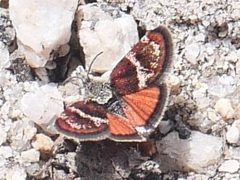
Gyros muirii is a small crambid described by Henry Edwards in 1881. It occurs in the Pacific Northwest region of North America, with records from California, Oregon, and Washington. fly from spring through mid-summer and are characterized by distinctive orange-brown forewings with dark markings. Two are recognized: the nominate form and G. m. rubralis from California.
Pronunciation
How to pronounce Gyros muirii: //ˈdʒaɪr.oʊs ˈmuɪr.i.aɪ//
These audio files are automatically generated. While they are not always 100% accurate, they are a good starting point.
Identification
Distinguished from similar small crambid by the combination of orange ground color with extensive blackish scaling on forewings, particularly the dark basal shading and central cloud. The lighter orange hindwings with narrow marginal border also aid identification. rubralis may show redder tones.
Images
Distribution
Pacific Northwest of North America: California, Oregon, and Washington.
Seasonality
active from March through July.
Similar Taxa
- Other Gyros speciesCongeneric share small size and crambid but differ in wing pattern details; G. muirii specifically identified by orange coloration with blackish markings.
- Small orange crambid moths (e.g., some Udea species)Similar size and general coloration, but Udea typically shows more uniform wing patterns or different marking arrangements without the distinct dark basal shading and central cloud.
More Details
Subspecies
Two recognized: Gyros muirii muirii and Gyros muirii rubralis (Warren, 1892), the latter restricted to California and presumably differing in coloration (rubralis suggesting redder tones).