
Thaumatopsis pexellus
Zeller, 1863
Woolly Grass-veneer, Woolly Grass-veneer Moth
Thaumatopsis pexellus is a grassland in the Crambidae, commonly known as the woolly grass-veneer. It occurs across most of North America and is active during late summer. The was described by Philipp Christoph Zeller in 1863. Multiple have been recognized, including forms restricted to Colorado, California, Alberta, and Mexico.
Pronunciation
How to pronounce Thaumatopsis pexellus: //θɔːməˈtɒpsɪs pɛkˈsɛləs//
These audio files are automatically generated. While they are not always 100% accurate, they are a good starting point.
Identification
Distinguished from similar crambid grass moths by its North American grassland distribution and late summer period (July to early September). The specific epithet and designations may require genitalia examination or molecular analysis for definitive identification.
Images
Appearance
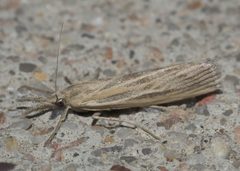
have a wingspan of 21–32 mm. The 'woolly grass-veneer' suggests a scaled or somewhat fuzzy appearance typical of crambid , though specific coloration details are not documented in available sources.
Habitat
Grasslands. The is strongly associated with open grassy environments across its range.
Distribution
Most of North America, including Canada (Alberta, Manitoba, Saskatchewan), the United States, and Mexico. show regional variation: T. p. coloradella in Colorado, California, and Alberta; T. p. strictalis in Mexico.
Seasonality
are active from July to early September throughout most of the range.
Diet
Larvae feed on various grasses. feeding habits are not documented.
Host Associations
- various grasses - larval food plantspecific grass not identified in available sources
Ecological Role
Larval herbivore in grassland . Specific ecological functions such as nutrient cycling or trophic interactions are not documented.
Human Relevance
No documented economic or cultural significance. Not known to be a pest of agricultural grasses.
Similar Taxa
- Other Thaumatopsis speciesSame , likely similar grassland and ; requires detailed examination to distinguish
- Other Crambinae grass mothsShared grassland and similar size range; identification relies on genitalia and geographic distribution patterns
More Details
Subspecies
Four recognized: T. p. pexellus (nominate), T. p. coloradella (Colorado, California, Alberta), T. p. gibsonella, and T. p. strictalis (Mexico). The geographic restriction of subspecies suggests potential local or incipient speciation.