
Microcrambus elegans
Clemens, 1860
Elegant Grass-veneer, Elegant Grass-veneer Moth
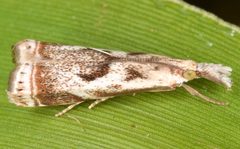
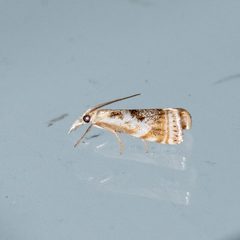
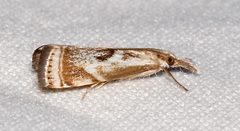
Microcrambus elegans is a small grass-veneer in the Crambidae, first described by James Brackenridge Clemens in 1860. It is recognized by its distinctive silvery-white wings with brown shading and a characteristic "Halloween-mask" facial pattern when viewed from above. The exhibits latitudinal variation in voltinism, with one per year in northern and multiple generations in the south. Larvae are grass-feeders, developing on members of the family Poaceae.
Pronunciation
How to pronounce Microcrambus elegans: /ˌmaɪkroʊˈkræmbəs ˈɛlɪɡænz/
These audio files are automatically generated. While they are not always 100% accurate, they are a good starting point.
Identification
The combination of small size (12–15 mm wingspan), silvery-white wings with brown shading, and the distinctive "Halloween-mask" pattern with seven black dots on the forewing margin distinguishes this from other grass-veneer moths. The snout-like projection formed by elongated labial palps is characteristic of the Crambinae but the specific facial pattern is diagnostic for M. elegans. Similar species in the Microcrambus may lack the bold mask pattern or have different wing markings.
Images
Appearance
A small with wingspan of 12–15 mm. Wings are silvery-white with brown shading in some areas. When at rest, wings are tightly folded into a tube-like shape. view shows a distinctive pattern resembling a Halloween mask: two triangular dark "" and a down-curved "mouth" marking. Seven black dots are present along the lowermost edge of the forewings. are threadlike and slender. Labial palps are long, hairy, and project forward, creating a snout-like appearance typical of Crambinae.
Habitat
Grassy areas, including meadows, fields, lawns, and other open with abundant grasses. The is closely associated with its larval plants in the Poaceae.
Distribution
Eastern and central North America: from Ontario, Quebec and Maine south to Florida, west to Texas, north to Kansas and Illinois. Records also from Vermont.
Seasonality
active June to August in northern parts of range; March to October in southern parts. One per year in the north; multiple generations in the south.
Diet
Larvae feed on grasses in the Poaceae. feeding habits are not documented.
Host Associations
- Poaceae - larval plantgrass
Life Cycle
Holometabolous. Larval stage feeds on grasses. occurs in silk-lined tunnels or chambers within the plant or soil. emerge and are active during the period. Voltinism varies by latitude: in north, multivoltine in south.
Behavior
rest with wings tightly folded, creating a cylindrical profile. or activity pattern inferred from . Larvae likely feed within grass stems or thatch, though specific feeding is not well documented.
Ecological Role
Herbivore in grassland . Larvae consume grasses, potentially contributing to nutrient cycling and serving as prey for and . Specific ecological impacts are minor given the ' small size and grass-feeding habits.
Human Relevance
Minor economic significance; may occasionally be present in lawns and turfgrass but not considered a pest of importance. No documented agricultural damage.
Similar Taxa
- Other Microcrambus speciesSimilar size, , and general appearance, but distinguished by wing pattern details, particularly the distinctive mask-like markings and marginal dots of M. elegans
- Fissicrambus mutabilisAnother small crambine grass-veneer with overlapping range; differs in wing pattern and resting posture details
More Details
Etymology
Specific epithet "elegans" refers to the refined or elegant appearance of the , likely alluding to its delicate silvery-white coloration.
Taxonomic History
First described by James Brackenridge Clemens in 1860, an American entomologist known for his work on Lepidoptera.
Sources and further reading
- BugGuide
- Wikipedia
- GBIF taxonomy match
- iNaturalist taxon
- NCBI Taxonomy
- Catalogue of Life
- Bring on the Tourists! | Bug Squad
- More Nematodes in Outer Space? | Bug Squad
- Showcasing Animal and Plant Parasitic Nematodes | Bug Squad
- Don't Miss the Nematode Collection at UC Davis Biodiversity Museum Day Feb. 10 | Bug Squad
- UC Davis Speaker: Fatma Kaplan, A Go-Getter and Maybe a Genius | Bug Squad
- Bug Eric: Wasp Wednesday: Steniolia elegans