
Chilonini
Hampson, 1898
Genus Guides
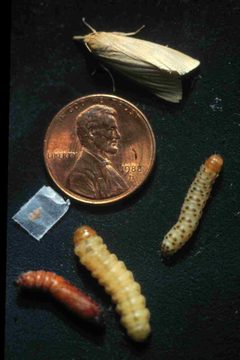
2Chilonini is a tribe of grass moths within the Crambidae. Members are generally small to medium-sized with narrow wings and slender bodies. The tribe includes several economically significant stem-boring pest , particularly in the Chilo, which attack cereal crops including maize, rice, and sugarcane. Chilonini species are distributed across tropical and temperate regions worldwide, with highest diversity in the Old World tropics.
Pronunciation
How to pronounce Chilonini: //kɪˈlɒnɪnaɪ//
These audio files are automatically generated. While they are not always 100% accurate, they are a good starting point.
Identification
Chilonini can be distinguished from related crambine tribes by genitalia characters, particularly the structure of the male valvae and female signa. Most have relatively uniform, pale to brownish forewings with subtle fasciation, lacking the bold patterns seen in many other Crambinae. The labial palps are usually prominent and porrect (projecting forward). Species-level identification generally requires dissection and examination of genitalia; external is often insufficient due to convergent similarities in coloration.
Images
Habitat
Primarily associated with grassland , including natural prairies, savannas, and agricultural fields. Many are tightly linked to Poaceae (grasses) as plants. range from lowland tropical rice paddies to temperate cereal-growing regions. Some species have expanded into anthropogenic environments following the spread of cultivated grasses.
Distribution
Widespread across tropical, subtropical, and temperate regions of all continents except Antarctica. Highest occurs in the Afrotropical, Oriental, and Australasian regions. Several have been introduced to the Americas through agricultural trade. The Chilo alone occurs across Africa, Asia, Australia, and parts of Europe.
Diet
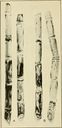
Larvae feed internally within stems of grasses (Poaceae). range varies by : some are restricted to wild grasses, while others are major pests of cultivated cereals including maize (Zea mays), rice (Oryza sativa), sorghum (Sorghum bicolor), and sugarcane (Saccharum officinarum). Larvae tunnel through stems, feeding on pith and vascular tissues.
Host Associations
- Zea mays - larval maize
- Oryza sativa - larval rice
- Saccharum officinarum - larval sugarcane
- Sorghum bicolor - larval sorghum
- Poaceae - larval wild and cultivated grasses
Life Cycle
Complete with four stages: , larva, pupa, . Females deposit eggs on or near plant stems. Larvae bore into stems, where they complete feeding and pupate within the tunnel. occurs inside the stem or in soil. Adults are generally short-lived and do not feed; is the primary activity. time varies from multiple generations per year in tropical regions to one or two in temperate zones.
Behavior
are and attracted to light. Larvae are cryptic, concealed within plant stems for most of their development. When disturbed, larvae may produce silk and drop from the plant on silken threads. Some show -dependent behavioral changes, with high larval densities promoting to new host plants.
Ecological Role
As primary consumers of grasses, larvae play roles in nutrient cycling and energy flow in grassland . In natural systems, they likely contribute to plant and provide food for stem-foraging and . In agricultural contexts, their ecological role is overshadowed by their status as economic pests.
Human Relevance
Several Chilonini rank among the most destructive insect pests of cereal agriculture worldwide. Chilo partellus (spotted stem borer) and Chilo suppressalis (striped rice stem borer) cause yield losses exceeding billions of dollars in Africa and Asia. Management relies on crop varieties, (including and Bacillus thuringiensis), and . The tribe has been extensively studied for strategies.
Similar Taxa
- CrambiniAnother tribe in Crambinae; distinguished by genitalia and often by more pronounced wing patterns
- SchoenobiinaeRelated crambid with stem-boring larvae; distinguished by wing venation and genitalia structure
- Noctuidae (stem borers)Unrelated containing similar stem-boring pests (e.g., Busseola fusca); distinguished by wing coupling mechanism and larval
More Details
Taxonomic instability
The tribal classification within Crambinae has undergone revision; some authorities have merged or split Chilonini with related groups. Current circumscription follows recent molecular phylogenetic studies supporting Chilonini as monophyletic.
Invasive species
Chilo partellus, native to Asia, has spread through much of sub-Saharan Africa since the 1930s, becoming a pest of maize and displacing some native stem borer through competitive superiority.