
Chrysendeton medicinalis
Grote, 1881
Bold Medicine Moth
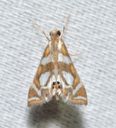
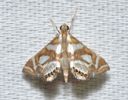
Chrysendeton medicinalis, commonly known as the bold medicine , is a small crambid moth native to eastern North America. It was described by Augustus Radcliffe Grote in 1881. The species is characterized by its distinctive white, ocherous, and brown wing patterning with silvery-white bands. are active nearly year-round in the southern portions of its range.
Pronunciation
How to pronounce Chrysendeton medicinalis: /ˌkɹɪˈsɛn.dɪˌtɒn ˌmɛd.ɪ.sɪˈnæ.lɪs/
These audio files are automatically generated. While they are not always 100% accurate, they are a good starting point.
Identification
The bold medicine can be distinguished from similar crambid by the continuous silvery-white sub-basal band that extends across both forewings and hindwings. The combination of white patch, curved white line, and the distinctive ocherous shade divided by a brown line between the median patch and costal band provides additional diagnostic characters. The small size (approximately 12 mm wingspan) and the specific arrangement of white bands on a brown-ocherous background separate it from and other small crambid moths in the same geographic region.
Images
Distribution
Eastern United States. Recorded from Alabama, Florida, Georgia, Illinois, Indiana, Kentucky, Maryland, Mississippi, North Carolina, Ohio, Pennsylvania, South Carolina, Tennessee, Texas, and West Virginia.
Seasonality
have been recorded on wing nearly year-round in the southern part of the range. Specific seasonal patterns in northern portions of the range are not documented.
More Details
Taxonomic history
Described by Augustus Radcliffe Grote in 1881. The epithet 'medicinalis' and 'bold medicine ' may suggest historical medicinal use, though this is not documented in available sources and may simply reflect the bold patterning of the wings.
Observation data
As of current records, iNaturalist documents 1,075 observations of this , indicating it is relatively well-recorded by citizen scientists within its range.
Sources and further reading
- BugGuide
- Wikipedia
- GBIF taxonomy match
- iNaturalist taxon
- Catalogue of Life
- Bug Eric: Spider Sunday: Coras
- Fascinating Invertebrates ~ Bring on the leeches! - Buglife Blog - Buglife
- A decade of Open Access: Zoosystematics and Evolution celebrates 10 years with Pensoft
- Conservation Translocations: It’s Not Just Beavers - Buglife Blog - Buglife