
Adaina
Tutt, 1905
Species Guides
7- Adaina ambrosiae(ragweed plume moth)
- Adaina bipunctatus(Three- and Two-dotted Plume Moth)
- Adaina ipomoeae(Pork Vine Plume Moth)
- Adaina montanus(Mountain Plume Moth)
- Adaina perplexus(Perplexing Plume Moth)
- Adaina simplicius(Three-dotted Plume Moth)
- Adaina thomae(St. Thomas Island Plume)
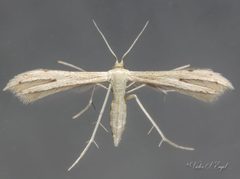
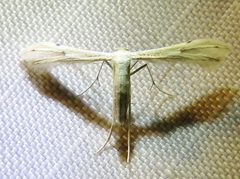
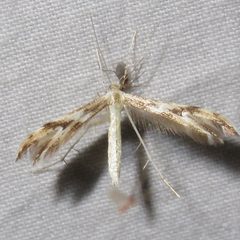
Adaina is a of plume moths (Pterophoridae) established in 1905, comprising approximately 42 described . The genus is characterized by split or divided wings typical of the , with species distributed across the Americas. Several species have documented larval associations with Asteraceae plants, with some exhibiting gall-inducing and others feeding on inflorescences.
Pronunciation
How to pronounce Adaina: /əˈdaɪ.nə/
These audio files are automatically generated. While they are not always 100% accurate, they are a good starting point.
Identification
within Adaina can be distinguished by wing pattern and genitalia . For example, A. azapensis and A. jobimi, though morphologically similar in larval form and feeding , are separated by distinct wing patterns and genitalia details. has been employed to confirm species boundaries, with sister species showing genetic distances around 7.8% (Kimura 2-parameter model).
Images
Habitat
have been documented in arid highlands of the western Andes slopes, transverse valleys of the Atacama Desert, and other South American environments. The occupies a range of across the Americas, though specific habitat preferences vary by species.
Distribution
Documented from North, Central, and South America. Specific records include: northern Chile (A. jobimi, A. azapensis, A. coquimboae), Argentina, Ecuador, and Peru (A. excreta). The discovery of A. jobimi filled a significant distribution gap in mainland South America west of the Andes Range.
Diet
Larvae of multiple feed on Asteraceae. A. jobimi and A. azapensis larvae are florivorous, feeding on inflorescences of Baccharis alnifolia and Pluchea chingoyo respectively. A. primulacea and A. microdactyla larvae induce stem galls on Chromolaena odorata and Eupatorium cannabinum. feeding habits are not documented.
Host Associations
- Baccharis alnifolia (Asteraceae) - larval A. jobimi larvae feed and pupate on inflorescences
- Pluchea chingoyo (Asteraceae) - larval A. azapensis larvae feed on inflorescences
- Chromolaena odorata (Asteraceae) - larval A. primulacea larvae induce stem galls
- Eupatorium cannabinum (Asteraceae) - larval A. microdactyla larvae induce stem galls
Life Cycle
Larvae of studied feed and pupate on plant inflorescences. Specific developmental stages and timing are documented for individual species but not generalized across the .
Behavior
Larval includes florivory (feeding on flowers) and gall induction. A. azapensis and A. jobimi exhibit similar larval feeding behaviors despite occupying different . are , as typical for Pterophoridae.
Ecological Role
As herbivores, larvae influence plant reproductive output through florivory or gall induction. Specific functions beyond herbivory are not documented.
Similar Taxa
- Other Pterophoridae generaAdaina share the divided wing characteristic of plume moths, but are distinguished by genitalia morphology and wing pattern details. analysis suggests the current circumscription of Adaina may require taxonomic revision.
More Details
Taxonomic uncertainty
Mitochondrial analysis of A. azapensis and A. jobimi supports their placement in Adaina but indicates that the current generic circumscription may need re-evaluation. The contains approximately 42 described as of 2023.
Distribution gaps
The discovery of A. jobimi in 2020 represented the first record of the west of the Andes Range in mainland South America, highlighting that Adaina diversity in underexplored regions remains incompletely documented.
Sources and further reading
- BugGuide
- Wikipedia
- iNaturalist taxon
- NCBI Taxonomy
- A new species of the plume moth genus Adaina Tutt (Lepidoptera, Pterophoridae) from the Atacama Desert, Chile
- Adaina jobimi sp. nov., a plume moth (Lepidoptera, Pterophoridae) associated with Baccharis alnifolia (Asteraceae) in the Andes of northern Chile
- Figure 12 from: Vargas HA (2020) Adaina jobimi sp. nov., a plume moth (Lepidoptera, Pterophoridae) associated with Baccharis alnifolia (Asteraceae) in the Andes of northern Chile. Nota Lepidopterologica 43: 329-336. https://doi.org/10.3897/nl.43.57965
- Figures 7-11 from: Vargas HA (2020) Adaina jobimi sp. nov., a plume moth (Lepidoptera, Pterophoridae) associated with Baccharis alnifolia (Asteraceae) in the Andes of northern Chile. Nota Lepidopterologica 43: 329-336. https://doi.org/10.3897/nl.43.57965
- Figures 1-6 from: Vargas HA (2020) Adaina jobimi sp. nov., a plume moth (Lepidoptera, Pterophoridae) associated with Baccharis alnifolia (Asteraceae) in the Andes of northern Chile. Nota Lepidopterologica 43: 329-336. https://doi.org/10.3897/nl.43.57965