
Calephelis borealis
(Grote & Robinson, 1866)
Northern Metalmark
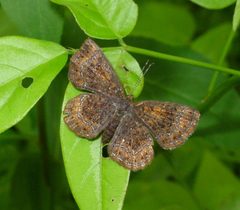
Calephelis borealis, the northern metalmark, is a small in the Riodinidae to the eastern United States. It is one of few tropical-associated riodinids found in eastern North America. The has declined across its range due to loss from afforestation and plant encroachment. Active management including thinning and invasive plant removal has been shown to increase local .
Pronunciation
How to pronounce Calephelis borealis: //kæ.ləˈfɛ.lɪs bɔˈriː.ə.lɪs//
These audio files are automatically generated. While they are not always 100% accurate, they are a good starting point.
Identification
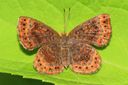
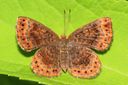
Wingspan 29–32 mm. Distinguished from other eastern metalmarks by its limited geographic range and association with limestone, shale, or serpentine barren . have the characteristic metalmark wing pattern with metallic spots, though specific diagnostic markings distinguishing it from are not documented in available sources.
Images
Habitat
Open woodland streams near serpentine, shale, or limestone barrens. Requires ecotonal structure with shade-loving larval hostplant spatially proximate to sun-loving nectar resources. Associated with eastern redcedar (Juniperus virginiana) and limestone soils. openness is critical; dense forest encroachment eliminates .
Distribution
Western Connecticut south through west-central Pennsylvania; central Appalachians and Ohio River Valley. Isolated in southwest Missouri, Arkansas, and eastern Oklahoma.
Seasonality
active mid-June to late July. One per year.
Diet
Larvae feed on leaves of Packera ovata (also referenced as P. obovata). feed on nectar from butterflyweed, white sweet clover, goldenrod, ox- daisy, sneezeweed, and yarrow.
Host Associations
- Packera ovata - larval hostplantprimary ; also referenced as Packera obovata
- Packera obovata - larval hostplantalternate spelling/referenced name for same
- Juniperus virginiana - associateeastern redcedar associated with occupied sites
Life Cycle
Overwinters as larva in leaf litter. One per year with emerging mid-June to late July.
Behavior
Exhibits metapopulation structure that buffers against climatic variability and precipitation fluctuations. Responds positively to active management including thinning and plant removal.
Human Relevance
Listed as endangered in Connecticut by state authorities. Classified as vulnerable globally by The Nature Conservancy. Subject of conservation management efforts including restoration.
Similar Taxa
- Calephelis australis with documented ; southern distribution distinguishes it
- Calephelis nemesis with documented ; different geographic range and association
Sources and further reading
- BugGuide
- Wikipedia
- iNaturalist taxon
- NCBI Taxonomy
- Bugs for All, All for Bugs | Bug Squad
- Grasshoppers of Wyoming and the West
- Grasshoppers of Colorado
- Grasshoppers of Colorado
- Sagebrush Grasshopper
- Zombie bees, Apis mellifera, and their tormentor the humpbacked fly, Apocephalus borealis — Bug of the Week
- THE LIFE HISTORY OF CALEPHELIS BOREALIS (LEPIDOPTERA)
- Mark-recapture study and habitat assessment for the northern metalmark butterfly, Calephelis borealis (Lepidoptera: Riodinidae)