
Calephelis nemesis
(Edwards, 1871)
Fatal Metalmark, Dusky Metalmark
Calephelis nemesis, commonly known as the fatal metalmark or dusky metalmark, is a small in the Riodinidae. It is distinguished by its modest wingspan of 20–25 mm and its association with arid environments in the southwestern United States and Mexico. The has been documented at the Tucson Gardens and is one of several Calephelis species with evocative names referencing loss or fate.
Pronunciation
How to pronounce Calephelis nemesis: //ˌkælɪˈfɛlɪs ˈnɛmɪsɪs//
These audio files are automatically generated. While they are not always 100% accurate, they are a good starting point.
Identification
Can be distinguished from similar metalmarks by its small size (20–25 mm wingspan) and geographic occurrence in the southwestern United States and Mexico. The C. n. nemesis occurs in northern Mexico and Arizona, C. n. australis in Texas, and C. n. californica and C. n. dammersi in California, potentially showing regional variation in appearance. The "fatal metalmark" distinguishes it from related such as Calephelis perditalis (lost metalmark).
Images
Appearance
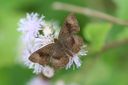
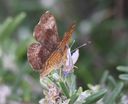
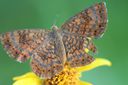
A small with a wingspan of 20–25 mm. The "dusky metalmark" suggests relatively subdued coloration compared to more brightly marked metalmarks. As with other members of the Calephelis, the wings likely bear the characteristic metallic spots or bands that give metalmark butterflies their common name, though specific pattern details for this are not well documented in the provided sources.
Habitat
Chaparral canyons near rivers in arid areas, roadsides, and washes. These environments provide the necessary plants and microclimates for larval development and activity.
Distribution
Southern United States (Arizona, Texas, California) and Mexico. Documented have more restricted ranges: C. n. nemesis in northern Mexico and Arizona, C. n. australis in Texas, C. n. californica and C. n. dammersi in California.
Diet
Larvae feed on Encelia californica, Baccharis glutinosa, Clematis drummondii, and Clematis henryi. feeding habits are not documented in the provided sources.
Host Associations
- Encelia californica - larval food plant
- Baccharis glutinosa - larval food plant
- Clematis drummondii - larval food plant
- Clematis henryi - larval food plant
Ecological Role
As a herbivore in its larval stage, this contributes to energy flow in arid riparian and chaparral . Its specialized feeding on particular plants may influence plant dynamics in its .
Human Relevance
Observed at the Tucson Gardens as part of the local fauna. The ' "fatal metalmark" has been noted as an example of evocative scientific in popular entomological literature.
Similar Taxa
- Calephelis perditalisBoth are small metalmarks in the Calephelis with names referencing loss or fate; C. perditalis is known as the "lost metalmark"
More Details
Subspecies
Four are recognized: C. n. nemesis (northern Mexico, Arizona), C. n. australis (Texas), C. n. californica (California), and C. n. dammersi (California). These were described or revised by McAlpine in 1971.
Etymology
The epithet "nemesis" refers to the Greek goddess of retribution, reflecting a theme of loss or fate shared with related species in the .
Sources and further reading
- BugGuide
- Wikipedia
- iNaturalist taxon
- NCBI Taxonomy
- Bug Eric: September 2010
- The best species name ever! | Beetles In The Bush
- Recyclers of the rainforest: Bornean myriapods, millipedes (Diplopoda), and their nemesis, giant centipedes (Chilipoda) — Bug of the Week
- Deadly dining: Three-lined potato beetle, Lema daturaphila — Bug of the Week
- Bugs in orange and black, predator and prey: Two-spotted stink bug, Perillus bioculatus, and Colorado potato beetle, Leptinotarsa decemlineata — Bug of the Week
- Bugs in orange and black, Part 3 – Trick or treat? Two-spotted stink bug, Perillus bioculatus, has a lethal trick that turns Colorado potato beetle, Leptinotarsa decemlineata, into a tasty treat — Bug of the Week