
Pieris marginalis
Scudder, 1861
margined white
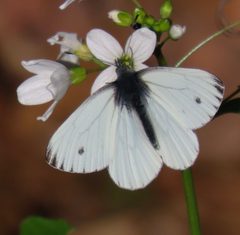
Pieris marginalis, commonly known as the margined white, is a distributed across western North America from the Yukon through Western Canada to the Rocky Mountains. It exhibits seasonal , with distinct spring and summer wing forms. The species utilizes plants in the Brassicaceae as larval and has been observed in both disturbed and undisturbed , suggesting ecological flexibility.
Pronunciation
How to pronounce Pieris marginalis: /ˈpaɪərɪs mɑrˈdʒɪnælɪs/
These audio files are automatically generated. While they are not always 100% accurate, they are a good starting point.
Identification
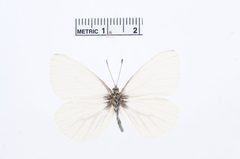
Distinguished from similar Pieris by the yellow-green or gray-green edging on wing visible on the underside of hindwing and apex of forewing. The seasonal (spring form with black-tipped forewings versus purely white summer form) is a key identifying feature. Very similar to Pieris oleracea, requiring careful examination of wing vein coloration for separation.
Images
Habitat
Occupies diverse environments across western North America including coastal areas, montane regions, and the Rocky Mountains. Observed in both disturbed and undisturbed , indicating adaptability to varied conditions. Described as a .
Distribution
Yukon, Western Canada, and the Rocky Mountains of North America. Distribution extends across coastal western North America. Specific provincial records include Alberta and Saskatchewan in Canada.
Seasonality
exhibit seasonal with distinct spring and summer forms. Spring form displays more extensive dark markings on forewings; summer form is predominantly white with reduced markings.
Diet
Larvae feed on plants in the Brassicaceae.
Similar Taxa
- Pieris oleraceaVery similar in appearance; distinguished by wing coloration and pattern details
- Pieris rapaeSimilar white coloration but differs in distribution pattern and wing markings; P. rapae is introduced and more associated with weedy disturbed
Sources and further reading
- BugGuide
- Wikipedia
- GBIF taxonomy match
- iNaturalist taxon
- NCBI Taxonomy
- Catalogue of Life
- Shapiro Records First-of-the-Year Cabbage White Butterfly: 'Pop Goes the Pieris' | Bug Squad
- Rejection in the World of Cabbage White Butterflies | Bug Squad
- No Contest, But Art Shapiro Spots First Cabbage White Butterfly of Year | Bug Squad
- He Nabbed It on New Year's Day | Bug Squad
- A Posse for the Pieiris? | Bug Squad
- A Butterfly for a Beer! Or Suds for a Bug! | Bug Squad