
Pieris angelika
Eitschberger, 1984
Arctic White
Pieris angelika, commonly known as the Arctic White, is a cold-adapted in the Pieridae. It occurs in subarctic and regions of northwestern North America. The was described by Eitschberger in 1984, though its taxonomic status may be subject to revision due to potential earlier descriptions. It is one of the few Pieris species specialized for high-latitude environments.
Pronunciation
How to pronounce Pieris angelika: /ˈpiːərɪs ænˈdʒɛlɪkə/
These audio files are automatically generated. While they are not always 100% accurate, they are a good starting point.
Identification
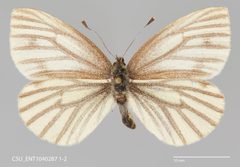
Distinguished from other Pieris by its restricted high-latitude distribution and specific wing pattern: males show thin black costal and marginal lines with dark green veining on the yellowish underside. Females exhibit more extensive dark scaling along compared to southern Pieris species. The combination of small size, cold-climate , and distinct wing patterning separates it from P. rapae and P. oleracea.
Images
Appearance
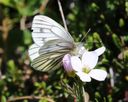
have a wingspan of 33–42 mm. Males are predominantly white above, with a thin black line along the and wing margin, plus variable black shading on the wings. The underside is pale yellow with dark green . Females are white or yellow with dark scaling and patches along the veins.
Habitat
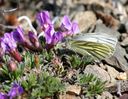
Subarctic and environments including tundra margins, taiga, and northern forest-steppe transitions. Occupies open with early-season flowering plants in regions with short growing seasons.
Distribution
Northwestern Canada (Yukon, Northwest Territories, northwestern British Columbia) and Alaska. Present across subarctic and northern zones of western North America.
Similar Taxa
- Pieris rapaeSimilar white coloration and wing pattern, but P. rapae occurs in temperate and subtropical regions, is larger on average, and lacks the dark green veining characteristic of P. angelika. P. rapae is a widespread agricultural pest, while P. angelika is restricted to undisturbed northern .
- Pieris oleraceaOverlaps in northern range but P. oleracea typically shows more extensive dark markings on the upperside and occurs in more eastern regions. P. angelika has a more restricted western subarctic distribution.
More Details
Taxonomic Uncertainty
The specific epithet may require revision if earlier descriptions (pre-1983) are validated, potentially affecting the accepted .
Cold Adaptation
One of the few Pieris adapted to true subarctic conditions, with persisting in environments with extremely short seasons.
Sources and further reading
- BugGuide
- Wikipedia
- GBIF taxonomy match
- iNaturalist taxon
- NCBI Taxonomy
- Shapiro Records First-of-the-Year Cabbage White Butterfly: 'Pop Goes the Pieris' | Bug Squad
- Rejection in the World of Cabbage White Butterflies | Bug Squad
- No Contest, But Art Shapiro Spots First Cabbage White Butterfly of Year | Bug Squad
- He Nabbed It on New Year's Day | Bug Squad
- A Posse for the Pieiris? | Bug Squad
- A Butterfly for a Beer! Or Suds for a Bug! | Bug Squad