
Itaballia demophile
(Linnaeus, 1763)
Cross-barred White, Crossbarred White, Black-banded White
Itaballia demophile is a small pierid distributed from the southern United States through Central America to Paraguay. It occupies disturbed and has a wingspan of 30–35 mm. The exhibits considerable geographic variation, with ten recognized . Larvae are specialized feeders on Capparis species.
Pronunciation
How to pronounce Itaballia demophile: /iː.təˈbæl.i.ə dɛˈmɒf.ɪˌlaɪ/
These audio files are automatically generated. While they are not always 100% accurate, they are a good starting point.
Identification
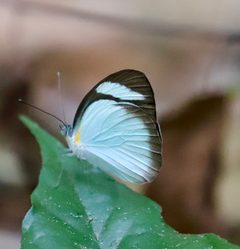
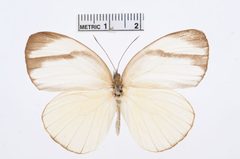
Distinguished from other white pierids by the presence of dark cross-bars on both forewings and hindwings, rather than marginal spots or checkered patterns. Resembles some of Leptophobia and Ascia, but differs in wing pattern details and geographic range. The combination of small size, white ground color, and transverse dark banding is diagnostic within its range.
Images
Appearance
Small with wingspan 30–35 mm. White wings with dark transverse bands or bars, the pattern and intensity of which varies among . is present, with females generally having more extensive dark markings than males.
Habitat
Disturbed open areas including forest clearings, riverbanks, roadsides, agricultural fields, cattle pastures, and wasteland. Avoids closed- forest. Thrives in anthropogenically modified landscapes.
Distribution
From the southern United States (Texas) through Mexico, Central America, and South America to Paraguay. Ten occupy distinct geographic ranges: I. d. calydonia in Belize, Venezuela, and Colombia; I. d. centralis in Guatemala and Honduras; I. d. charopus in Amazonian Brazil; I. d. demophile in Guyana; I. d. huebneri in Brazil; I. d. lucania in Peru, Ecuador, and Bolivia; I. d. nimietes in Bahia, Brazil; I. d. niphates in Pará, Brazil; and I. d. niseias in Paraguay.
Diet
Larvae feed on leaves of Capparis (Capparaceae), specifically documented on Capparis indica and Capparis frondosa. diet not documented in sources.
Host Associations
- Capparis indica - larval food plantdocumented
- Capparis frondosa - larval food plantdocumented
Similar Taxa
- Leptophobia speciesSimilar white wing coloration, but Leptophobia lacks the distinct transverse dark banding pattern and typically shows more marginal spotting.
- Ascia monuste (Great Southern White)Overlaps in range and preference, but larger (wingspan 48–65 mm) and has checkered wing margins rather than transverse bands.
- Pieris speciesSimilar size and white coloration, but Pieris have black wingtip markings and spots rather than cross-bars; also largely in distribution.
More Details
Taxonomic history
Originally described as Papilio demophile by Linnaeus in 1763. Transferred to Itaballia, established by Kaye in 1904 to accommodate previously placed in Pieris and related genera.
Subspecies diversity
The ten recognized show substantial variation in the extent and intensity of dark wing markings, with some appearing almost entirely white and others heavily banded. This variation has led to extensive taxonomic subdivision in the early 20th century, primarily by Fruhstorfer (1907).