
Ascia monuste
(Linnaeus, 1764)
Great Southern White, pirpinto
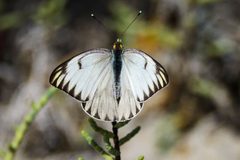
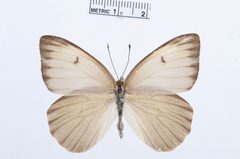
Ascia monuste, commonly known as the Great Southern White, is a pierid and the sole member of its . It is a Brassicaceae and a major herbivore of this plant in the Neotropical region. The exhibits , with females occurring in both light and dark color morphs. It ranges from the Atlantic and Gulf coasts of the United States through tropical America to Argentina, with migratory along the southeastern U.S. coast.
Pronunciation
How to pronounce Ascia monuste: /ˈæ.ski.a moʊˈnus.teɪ/
These audio files are automatically generated. While they are not always 100% accurate, they are a good starting point.
Identification
is pronounced: males are uniformly white, while females occur in two morphs—either white with dark wing margins or predominantly dark gray to black. The is the only member of the Ascia, distinguishing it from other pierids. Larvae are gregarious until the third instar, after which they disperse.
Images
Habitat
Vegetable gardens and agricultural areas with Brassicaceae plants; occurs in open, disturbed across its range.
Distribution
Atlantic and Gulf coasts of the United States, south through tropical America to Argentina; migratory along the southeastern U.S. coast with occasional strays northward. Specific collection and observation sites include Ribeirão Preto, São Paulo, Brazil; Cimitarra, Los Santos, Piedecuesta, Tona, Villavicencio, and Risaralda, Colombia; and various locations in North America.
Diet
Specialized herbivore of Brassicaceae; larvae feed on common kale (Brassica oleracea var. acephala) and other cruciferous vegetables. Newly hatched larvae consume ( shell) as their first food, which positively affects subsequent performance. of unhatched eggs occurs when hatching is asynchronous.
Host Associations
- Brassica oleracea var. acephala - larval food plantcommon kale
- Brassicaceae - -level specializationcruciferous vegetables
Life Cycle
to caterpillar to to . Larvae are gregarious until the third instar, then disperse. Development time and rates are faster and higher on young leaves compared to old leaves. ingestion by first-instar larvae improves adult performance metrics including time to pupation, adult emergence, and male weight.
Behavior
Females preferentially oviposit on young leaves despite no difference in number per female between leaf ages, suggesting compensatory mechanisms for lower nutritional quality of older foliage. recognition is mediated by glucosinolates. Larvae exhibit when hatching is asynchronous, consuming unhatched eggs after ingesting their own .
Ecological Role
One of the main herbivores of Brassicaceae in the Neotropical region; causes considerable damage to plants and competes with humans for Brassicaceae crops.
Human Relevance
Agricultural pest of cruciferous vegetable crops; economic impact on Brassicaceae in the Neotropics.
Similar Taxa
- Other PieridaeA. monuste is the sole member of Ascia, distinguishing it from other pierid genera; with female dark morphs is distinctive
- Ascia monuste monuste with same associations and , distinguished by geographic distribution and minor morphological differences
More Details
Nutritional ecology
Young leaves support better larval performance (faster development, higher rates, better digestive ) than old leaves due to higher nitrogen content and lower toughness in young foliage. Females compensate for this quality difference through selective oviposition rather than adjusting number.
Chorion ingestion significance
Ingestion of ultraviolet-sterilized provides the same performance benefits as unsterilized chorion, indicating nutritional rather than microbial benefits. This is linked to of unhatched when hatching asynchrony occurs.
Sources and further reading
- BugGuide
- GBIF taxonomy match
- iNaturalist taxon
- NCBI Taxonomy
- Catalogue of Life
- Platystomatidae | Beetles In The Bush
- Performance and host preference of Ascia monuste (Lepidoptera, Pieridae)
- Biology and Life History of <I>Ascia monuste monuste</I> (Lepidoptera: Pieridae), a Potential Pest of Cruciferous Vegetables
- Effect of host age on the oviposition and performance of Ascia monuste Godart (Lepidoptera: Pieridae)
- Oviposition behavior and performance aspects of Ascia monuste (Godart, 1919) (Lepidoptera, Pieridae) on kale (Brassica oleracea var. acephala)
- Influence of chorion ingestion on the performance of Ascia monuste and its association with cannibalism