
Colias meadii
Edwards, 1871
Mead's Sulphur, Mead's Sulfur
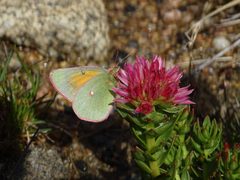
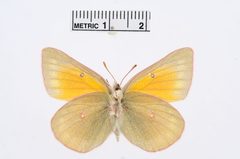
Colias meadii, known as Mead's Sulphur, is a in the Pieridae native to the Rocky Mountains of North America. It inhabits high-elevation arctic-alpine environments near or at tree line. The species is active during mid-summer, with flying from July to August. It exhibits the yellow-orange wing coloration typical of sulphur butterflies, with a wingspan of 35–44 mm.
Pronunciation
How to pronounce Colias meadii: /ˈkoʊ.li.əs ˈmi.aɪ/
These audio files are automatically generated. While they are not always 100% accurate, they are a good starting point.
Identification
Distinguished from other Colias by its restricted high-elevation arctic-alpine in the Rocky Mountains and its mid-summer period (July–August). The three recognized occupy different geographic portions of the range: C. m. meadii in Colorado, Utah, New Mexico, Wyoming, and Montana; C. m. elis in Alberta and British Columbia; and C. m. lemhiensis in Idaho and Montana. Accurate identification to subspecies level requires knowledge of collection locality.
Images
Appearance
Medium-sized with wingspan 35–44 mm. Wings yellow to orange-yellow, typical of sulphur butterflies. Wing pattern details not specified in available sources.
Habitat
Arctic-alpine tundra and rocky slopes in high mountain areas at or near tree line. Occupies elevations where vegetation is sparse and conditions are harsh.
Distribution
Rocky Mountains in Canada and the United States. Specific range encompasses: Colorado, Utah, New Mexico, Wyoming, Montana, Idaho, Alberta, and British Columbia.
Seasonality
active from July to August. Single period per year.
Diet
Larvae feed on Trifolium , Astragalus alpinus, Oxytropis deflexa, and Vicia americana. feed on flower nectar from alpine sunflower and asters.
Host Associations
- Trifolium - larval level
- Astragalus alpinus - larval
- Oxytropis deflexa - larval
- Vicia americana - larval
- alpine sunflower - nectar source
- asters - nectar source level
Life Cycle
Complete with , larva, pupa, and stages. Specific duration of developmental stages not documented. stage not specified in available sources.
Ecological Role
function as of alpine flowering plants. Larvae are herbivores that consume leguminous plants. Specific ecological impacts not quantified in available sources.
Human Relevance
Subject of entomological study due to its restricted alpine and sensitivity to climate change. Not known to be of agricultural or economic significance.
Similar Taxa
- Colias eurythemeAlso yellow-orange sulphur , but occupies lowland agricultural and urban , not high-elevation alpine tundra. period broader, typically multiple .
- Colias behriiAnother alpine sulphur in western North America, but restricted to Sierra Nevada range rather than Rocky Mountains.
- Colias croceusEuropean with similar coloration; distinguished by geographic separation and migratory not observed in C. meadii.
More Details
Subspecies
Three recognized: C. m. meadii (Colorado, Utah, New Mexico, Wyoming, Montana); C. m. elis Strecker, 1885 (Alberta, British Columbia); C. m. lemhiensis Curtis & Ferris, 1985 (Idaho, Montana). Subspecies differentiation based on geographic distribution rather than pronounced morphological differences.
Conservation Context
Arctic-alpine specialization makes this potentially vulnerable to climate change, as suitable habitat is restricted to narrow elevational bands near tree line.
Sources and further reading
- BugGuide
- Wikipedia
- GBIF taxonomy match
- iNaturalist taxon
- NCBI Taxonomy
- Catalogue of Life
- A Butterfly Invasion in Yolo, Solano and Sacramento Counties | Bug Squad
- 'Battus philenor! Battus philenor!' | Bug Squad
- A Boy, Bugs, a Birthday and the Bohart | Bug Squad
- The Joy of Rearing Monarchs | Bug Squad
- Thinking of Noted Cotton Entomologist Thomas Frances Leigh | Bug Squad
- Insect Migration (Part 1) - Buglife Blog - Buglife