
Papilio machaon aliaska
Scudder, 1869
Alaskan Old World Swallowtail
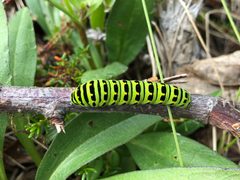
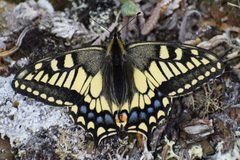
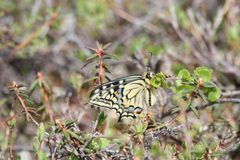
Papilio machaon aliaska is a of the Old World Swallowtail butterfly found in Alaska. It represents a distinct that has colonized novel plants in the Asteraceae in addition to its ancestral Apiaceae hosts. Studies indicate that larval is highest on the ancestral host plant Cnidium cnidiifolium when reared in controlled environments without , though field observations suggest survival advantages on novel hosts when natural enemies are present. The subspecies demonstrates the complex ecological and evolutionary dynamics of host plant relationships in swallowtail butterflies.
Pronunciation
How to pronounce Papilio machaon aliaska: /pəˈpɪlioʊ məˈka.oʊn əˈliːæskə/
These audio files are automatically generated. While they are not always 100% accurate, they are a good starting point.
Identification
Distinguished from other P. machaon by its Alaskan distribution. Specific morphological differences from nominate P. machaon and other subspecies are not documented in available sources. likely share the characteristic yellow and black banded wing pattern of the . Larvae presumably possess the osmeterium (forked, eversible gland) typical of papilionid caterpillars, though this is inferred from -level traits and not explicitly confirmed for this subspecies.
Images
Habitat
Central Alaska; specific types not detailed in available sources. Occurs in environments supporting its three known plant .
Distribution
Alaska, North America. GBIF records also indicate presence in Europe and the European Union, though these may represent data entry artifacts or reflect the broader range rather than this specifically.
Diet
Larvae feed on three documented plant : Cnidium cnidiifolium (Apiaceae, ancestral host), Artemisia arctica (Asteraceae, novel host), and Petasites frigidus (Asteraceae, novel host). diet not specified in available sources.
Host Associations
- Cnidium cnidiifolium - larval plant (ancestral)Apiaceae ; provides highest larval in controlled rearing studies without
- Artemisia arctica - larval plant (novel)Asteraceae ; colonized relatively recently by P. machaon group
- Petasites frigidus - larval plant (novel)Asteraceae ; colonized relatively recently by P. machaon group
Life Cycle
Complete with , larva, pupa, and stages. Larval development studied in detail; metrics include rate, pupal mass, and rate. Specific duration of developmental stages not documented in available sources.
Ecological Role
as . Larval herbivore on three documented plant . Potential prey for natural enemies in field environments, with host plant choice affecting survival when present.
Similar Taxa
- Papilio machaon (nominate subspecies)Same ; P. m. aliaska distinguished by Alaskan distribution and documented use of Asteraceae plants not typical of European
- Other Papilio machaon subspeciesGeographic separation and plant associations; P. m. aliaska specifically documented to use Artemisia arctica and Petasites frigidus, which are not ancestral hosts for the
Sources and further reading
- BugGuide
- GBIF taxonomy match
- iNaturalist taxon
- NCBI Taxonomy
- Bird droppings, snake eyes, dead leaves: Swallowtails, Papilio spp. — Bug of the Week
- Papilionoidea | Blog
- Swallowtails where art thou? Swallowtail butterflies, Papilionidae — Bug of the Week
- Provisional checklist of European butterfly larval foodplants
- Parsley poacher: Black swallowtail caterpillar, Papilio polyxenes — Bug of the Week
- Swallowtail soiree - Papilio glaucus — Bug of the Week
- The effect of host plant on larval survivorship of the Alaskan swallowtail butterfly (Papilio machaon aliaska)
- The effect of host plant on larval survivorship of the Alaskan swallowtail butterfly (Papilio machaon aliaska)