
Papilio anchisiades
Esper, 1788
ruby-spotted swallowtail, red-spotted swallowtail
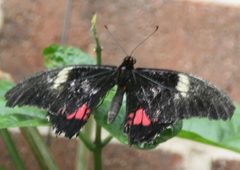
Papilio anchisiades is a medium to large with a wingspan of 70–100 mm, distributed from southern Texas through Central America to Argentina. The exhibits considerable geographic variation across its range, with multiple recognized . Larvae feed on Rutaceae, particularly Citrus species, and are commonly observed drinking at moist ground near rivers rather than in forested .
Pronunciation
How to pronounce Papilio anchisiades: //pəˈpɪlioʊ ænˈkaɪsiˌeɪdiːz//
These audio files are automatically generated. While they are not always 100% accurate, they are a good starting point.
Identification
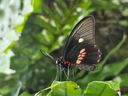
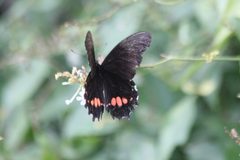
Distinguished from similar swallowtails by the reduced or absent tail on the hindwing (except in some females), and by the arrangement of red spots on the hindwing underside in two rows that are partly contiguous. The idaeus has a distinct white spot at the end of the forewing , while capys lacks white spots on the forewing upperside entirely. The variable white spotting pattern on the forewing separates anchisiades from the more uniformly marked capys form.
Images
Habitat
Not a forest . are fond of drinking at moist places on banks of rivers. Larvae are often found on cultivated Citrus and related Rutaceae in open or semi-open .
Distribution
Southern Texas south through Mexico and Central America to Panama; South America from Colombia, Venezuela, and the Guianas south to Peru, Bolivia, Brazil, Paraguay, and Argentina. Rare strays recorded in Kansas, southeastern Arizona, and western Texas.
Diet
Larvae feed on various Rutaceae, including Citrus, Casimiroa, and Zanthoxylum . feed on flower nectar.
Host Associations
- Citrus sinensis - larval Survival lower than on C. reticulata when larvae reared individually; survival increased when multiple larvae reared together
- Citrus reticulata - larval Greater larval survival than on C. sinensis under individual rearing conditions
- Casimiroa - larval
- Zanthoxylum - larval
Life Cycle
Complete with , larva, pupa, and stages. Larvae often rest together in hundreds on stems of Citrus. Developmental timing varies by plant: stadium longevity decreases on Citrus sinensis when multiple larvae are reared together, while survival increases; on C. reticulata, survival remains stable under similar conditions.
Behavior
Larvae exhibit gregarious resting , often aggregating in large numbers on plant stems. engage in puddling behavior, gathering at moist ground near riverbanks to drink. Not a forest-dwelling ; adults are active in open and riparian .
Ecological Role
serve as when feeding on flower nectar. Larvae function as herbivores on Rutaceae, with potential economic impact on cultivated citrus. The has been evaluated as a candidate for sustainable farming in .
Human Relevance
Larvae can occur in large numbers on cultivated Citrus, potentially causing defoliation. The has been explored as an economically viable candidate for farming in the Peña Roja of the Colombian Amazon, where it was found to be biologically, economically, and socially sustainable for commercial purposes. are sought after by butterfly collectors and for live butterfly exhibits.
Similar Taxa
- Papilio thoasSimilar size and coloration, but P. anchisiades lacks the prominent tail and has distinctive red spot arrangement on hindwing
- Papilio cresphontesBoth large with spotted hindwings, but P. cresphontes has more extensive yellow banding and different spot pattern
More Details
Subspecies
Five recognized : P. a. anchisiades (Venezuela, Colombia to Guianas, Peru); P. a. capys (Bolivia to Paraná, Argentina, Paraguay, Brazil); P. a. idaeus (Texas, Mexico to Panama); P. a. lamasi (Ecuador); P. a. philastrius (Trinidad). The ruby-spotted swallowtail name applies primarily to the idaeus subspecies.
Etymology
The specific epithet anchisiades follows Classical tradition, referring to the Graeco-Roman Anchisiades.
Farming viability
Research in Colombian Amazon found survival rates and plant compatibility sufficient for commercial farming, with higher survival on Citrus reticulata than C. sinensis under individual rearing, though group rearing improved outcomes on C. sinensis.
Sources and further reading
- BugGuide
- Wikipedia
- GBIF taxonomy match
- NCBI Taxonomy
- Catalogue of Life
- Bird droppings, snake eyes, dead leaves: Swallowtails, Papilio spp. — Bug of the Week
- Papilionoidea | Blog
- Swallowtails where art thou? Swallowtail butterflies, Papilionidae — Bug of the Week
- Parsley poacher: Black swallowtail caterpillar, Papilio polyxenes — Bug of the Week
- Swallowtail soiree - Papilio glaucus — Bug of the Week
- Swallowtail soiree – Eastern tiger swallowtail, Papilio glaucus — Bug of the Week
- Development Cycle and Hosts of Heraclides Anchisiades Anchisiades (Lepidoptera: Papilionidae). An Exploratory Model of the Butterflies Farming Sustainability At"peña Roja"indigenous Community