
Eurytides philolaus
(Boisduval, 1836)
Dark Kite-Swallowtail, Dark Zebra Swallowtail
Eurytides philolaus is a in the Papilionidae, ranging from southern Texas through Mexico and Central America to northern South America. It is characterized by dark wings with reduced pale green markings compared to related . frequent low-lying areas near rivers, often gathering in groups on sandy banks. The species exhibits and female , with one form resembling the male and a darker melanistic form.
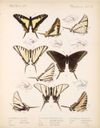
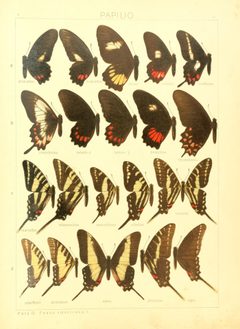
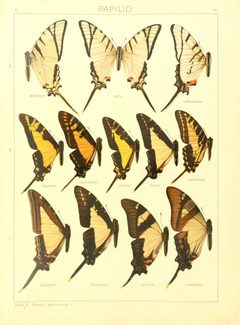
Pronunciation
How to pronounce Eurytides philolaus: //jʊˈrɪtɪˌdiːz ˌfɪloʊˈlaʊs//
These audio files are automatically generated. While they are not always 100% accurate, they are a good starting point.
Identification
Distinguished from the zebra swallowtail (Eurytides marcellus) by darker overall coloration and reduced pale green markings—forewing band represented by a spot rather than full stripes. The two red hindwing spots and black-edged red line on the under surface are diagnostic. Females in the dark form (f. niger) may be confused with other dark swallowtails but show faint traces of the pale band pattern. The lacks the extensive pale green striping of E. marcellus and related species.
Images
Appearance
Wingspan 90–95 mm. Forewings dark with pale green band reduced to a single spot on the seventh position. Hindwings bear two red spots posteriorly. black. Under surface of hindwing shows red line edged with black on both sides, undulating anteriorly. Male scent short, broad, irregular, with filamentous projections. Female occurs in two forms: f. philolaus resembles male with paler underside; f. niger (also called nigrescens or felicis) has pale green bands obscured by black scaling, producing nearly black wings with faint trace bands.
Habitat
Low-lying situations, particularly along rivers and streams. frequently observed resting on sandy banks at water edges. Associated with riparian environments in tropical and subtropical regions.
Distribution
Southern Texas (USA) through Mexico, Honduras, Rica, Panama, to northern Colombia and northern Venezuela. Two recognized: E. p. philolaus (Mexico, Honduras, Costa Rica, southern Texas) and E. p. xanticles (Panama, northern Colombia, northern Venezuela).
Diet
Larvae feed on in the Annonaceae (custard apple family). feeding habits not documented in available sources.
Host Associations
- Annonaceae - larval plant Specific plant within Annonaceae not identified in available sources
Life Cycle
Complete with , larva, pupa, and stages. Detailed not documented in available sources.
Behavior
have been observed resting in on sandy riverbanks. Males possess specialized scent presumably used in courtship, though specific not described.
Ecological Role
Larval herbivore on Annonaceae. likely serves as , though specific interactions not documented. Potential prey for birds and other .
Human Relevance
Featured on a 15-cent postage stamp from Belize alongside the magnificent frigatebird (Fregata magnificens). Not known to be of agricultural or economic significance.
Similar Taxa
- Eurytides marcellus (Zebra Swallowtail)Similar size and general form, but E. marcellus has extensive pale green stripes on forewings and lacks the two red hindwing spots characteristic of E. philolaus. E. marcellus is also restricted to eastern North America where pawpaw (Asimina triloba) serves as larval .
- Other Eurytides speciesSeveral Neotropical share the kite-swallowtail wing shape, but differ in pattern details of pale green markings and presence/absence of red spots on hindwings.
More Details
Taxonomic note
The has been treated under both Eurytides and Protographium by different authorities. GBIF currently lists Eurytides philolaus as a synonym of Protographium philolaus, though iNaturalist and NCBI retain Eurytides. The -level placement remains under discussion.
Female polymorphism
The existence of two distinct female forms—one mimicking the male and one melanistic—suggests potential mimicry or thermoregulatory , though the evolutionary significance has not been studied.