
Eurytides marcellus
(Cramer, 1777)
Zebra Swallowtail
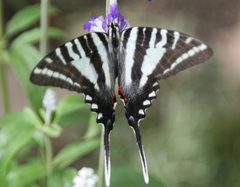
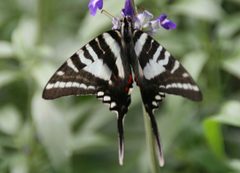
Eurytides marcellus, commonly known as the zebra swallowtail, is a striking native to eastern North America. It is immediately recognizable by its distinctive black-and-white longitudinal stripes, triangular wings, and long swordlike tails. The exhibits strong ecological dependence on pawpaw trees (Asimina spp.), which serve as the exclusive larval plants. Two seasonal forms occur: spring forms are smaller with shorter tails and more white coloration, while summer forms are larger with broader black stripes and longer tails. The zebra swallowtail is the official state of Tennessee and has been documented as far north as southern Canada, with recent range expansions facilitated by pawpaw plantings.
Pronunciation
How to pronounce Eurytides marcellus: //juːˈrɪtɪˌdiːz mɑːrˈsɛləs//
These audio files are automatically generated. While they are not always 100% accurate, they are a good starting point.
Identification
The zebra swallowtail is unlikely to be confused with any other North American due to its unique combination of features. The long, swordlike tails and bold black-and-white longitudinal striping are diagnostic. The only superficially similar , the giant swallowtail (Papilio cresphontes), is much larger, has yellow and black patterning rather than white and black, and has shorter, more rounded tails. The zebra swallowtail's triangular wing shape and distinctive striping pattern are immediately recognizable. Seasonal forms can be distinguished by tail length and overall size: spring forms have short tails with white tips, summer forms have longer tails with white edges.
Images
Habitat
Deciduous woodlands, forest edges, riparian corridors, and bottomland forests where pawpaw trees (Asimina spp.) occur. Strongly associated with mesic to wet-mesic including ravines, stream banks, and bluff bases. frequently visit open areas, gardens, and roadsides near woodland habitats. The is rarely found far from stands of larval plants.
Distribution
Eastern United States from southern New England and the Great Lakes region south to Florida and west to eastern Texas, Oklahoma, and Kansas. Northern limit extends into southeastern Canada (Ontario). Historical northernmost records from Pennsylvania and southern Ontario; recent range expansion documented with 2024 observations in Pittsburgh, Pennsylvania and 2025 observation in Toronto, Ontario—first in that area since 1896. State of Tennessee.
Seasonality
period extends from late March through August in northern portions of the range, and from February through December in southern portions. Two in northern areas, with the first brood being most numerous; three to four broods in southern areas. Spring-emerging adults (first brood) correspond to the smaller, paler seasonal form; summer-emerging adults correspond to the larger, darker seasonal form.
Diet
Larvae feed exclusively on leaves of pawpaw (Asimina spp.), including A. triloba (common pawpaw), A. angustifolia (slimleaf pawpaw), A. incana (woolly pawpaw), A. parviflora (smallflower pawpaw), A. reticulata (netted pawpaw), and A. tetramera (four-petal pawpaw). Larvae have also been documented accepting Annona muricata (soursop) in experimental conditions. feed on flower nectar from diverse plant including Apocynaceae, Brassicaceae, Fabaceae, Lythraceae, Polemoniaceae, and Rosaceae. Males engage in puddling , obtaining salts and from damp soil, sand, gravel, and other moist substrates. Additional adult food sources include rotting fruit and urine.
Host Associations
- Asimina triloba - larval common pawpaw, most widespread
- Asimina angustifolia - larval slimleaf pawpaw
- Asimina incana - larval woolly pawpaw
- Asimina parviflora - larval smallflower pawpaw
- Asimina reticulata - larval netted pawpaw
- Asimina tetramera - larval four-petal pawpaw, to Florida
- Annona muricata - experimental larval soursop; accepted in 1998 study but not natural
Life Cycle
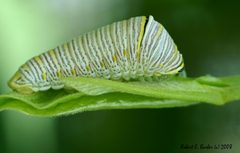
Females lay singly on pawpaw leaves or tree trunks, as caterpillars are cannibalistic. Eggs are round, pale green, turning orange-brown. Larvae pass through five instars; young caterpillars are black with lighter transverse stripes. Older larvae have two color forms: green with yellow and white transverse stripes (more common), or black banded with white and orange (rarer). Both forms have a yellow, black, and bluish-white band between the swollen and . Larvae possess a yellow, foul-smelling, forked osmeterium used to deter , especially spiders and ants. occurs in a green or brown chrysalis that is more compact than Papilio chrysalids, with three small horns projecting from and thorax. Chrysalis hibernates in areas with cold winters; multivoltine in southern range.
Behavior
Males patrol swiftly and directly 0.5 to 1.8 meters above ground near plants in search of females. Females fly slowly when searching for suitable host plants. Both sexes are avid flower visitors. Males congregate in puddling on moist substrates to obtain reproductive nutrients. are strong, direct fliers. Males are territorial and will investigate intruders.
Ecological Role
Larval stage functions as herbivore on pawpaw trees, sequestering neurotoxic annonaceous acetogenins from plants; these compounds are retained in tissues and may provide chemical defense against vertebrate . Adults serve as of diverse flowering plants. Larval may regulate . The is considered a flagship for pawpaw conservation and woodland preservation.
Human Relevance
Official state of Tennessee. Subject of conservation efforts involving pawpaw plantings to restore historical range; successful re-establishment documented in Pittsburgh, Pennsylvania in 2024. Popular among butterfly watchers and photographers due to distinctive appearance and relative approachability. Not a significant agricultural pest. Caterpillar plants (pawpaws) produce edible fruit, creating potential for conflict between fruit growers and butterfly conservation, though this appears minimal in practice.
Similar Taxa
- Papilio cresphontesGiant swallowtail is larger, has yellow and black (not white and black) pattern, shorter rounded tails, and different wing shape
- Papilio glaucusEastern tiger swallowtail has yellow or black color morphs with vertical black stripes or solid dark wings, much shorter tails, and lacks the zebra striping pattern
More Details
Chemical defense
Both larvae and sequester annonaceous acetogenins from pawpaw plants. These neurotoxic compounds may deter bird .
Taxonomic history
Has been classified under multiple including Protographium, Iphiclides, Graphium, and Papilio; currently placed in Eurytides by most authorities though Protographium is used by some sources.
Recent range dynamics
Historical northern limit in Pennsylvania and southern Ontario; local extirpation from parts of northern range followed by recent recolonization efforts. First Toronto record since 1896 in 2025.