
Junonia evarete
Cramer, 1782
South American Tropical Buckeye, tropical buckeye, West Indian buckeye
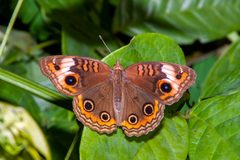
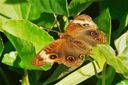
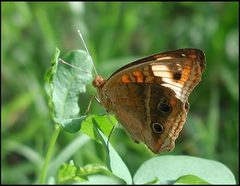
Junonia evarete is a Neotropical nymphalid ranging from Florida and the Caribbean through Mexico, Central America, and into tropical and subtropical South America. In Colombia's Ciénaga Grande de Santa Marta, its larvae act as significant herbivores on mangrove seedlings, with caterpillars feeding exclusively on Avicennia germinans , seedlings, and pneumatophores. The shows pronounced seasonality, abundant during the main rainy season and absent during the dry season. This feeding can cause complete seedling mortality at some sites, strongly inhibiting mangrove forest in disturbed .
Pronunciation
How to pronounce Junonia evarete: //dʒuːˈnoʊniə ɛˈværɛti//
These audio files are automatically generated. While they are not always 100% accurate, they are a good starting point.
Images
Habitat
Disturbed mangrove forests in brackish lagoon systems, particularly open, disturbed sites with exposed conditions. Associated with Avicennia germinans-dominated areas. Seasonally present during main rainy season; absent during dry season.
Distribution
Neotropical region: Florida, Caribbean islands, Mexico, Central America, and tropical to subtropical South America. Type locality: Suriname. Documented in Colombia at Ciénaga Grande de Santa Marta, Nariño (San Isidro, Reserva Natural La Planada), Leticia, Montería, Bolívar (Turbaco), and San Andrés.
Seasonality
Abundant during main rainy season, coinciding with peak fruit production of plant Avicennia germinans. Disappears during dry season. Specific mechanism (, , or local extinction) not documented.
Diet
Larval stage feeds exclusively on Avicennia germinans: , seedlings, and pneumatophores. Strong preference for young seedlings over older plants; larvae do not feed on mature trees. diet not documented in available sources.
Host Associations
- Avicennia germinans - obligate larval Exclusive for larvae; feeding limited to , seedlings, and pneumatophores
Behavior
Larval feeding concentrated on young seedlings, with older plants avoided. Caterpillars can cause 100% mortality of seedlings at heavily attacked sites. Seasonal tightly synchronized with plant and regional rainfall patterns.
Ecological Role
Herbivore acting as a significant limiting factor for mangrove forest in disturbed . Controls recruitment and survival of Avicennia germinans through seedling . Inhibits recovery of mangrove forests following disturbance events such as hypersalinization-induced die-back.
Similar Taxa
- Junonia coeniaCommon buckeye; similar and pattern, but J. evarete distinguished by Neotropical distribution and specialized mangrove-feeding versus J. coenia's broader range and North American temperate distribution
More Details
Taxonomic complexity
Extensive synonymy exists for this ; older literature must be used with caution. Numerous have been described across its broad Neotropical range.
Conservation significance
In Colombia's Ciénaga Grande de Santa Marta, where approximately 60% of mangrove forests died from hypersalinization beginning in 1964, J. evarete herbivory compounds challenges. Seedling protection methods (insect nets, dry-season germination timing, cover) may improve restoration success.
Sources and further reading
- BugGuide
- GBIF taxonomy match
- iNaturalist taxon
- NCBI Taxonomy
- Catalogue of Life
- A 'Firecracker of a Surprise' in Davis: Who Knew? | Bug Squad
- A Close Call | Bug Squad
- Mary Louise Flint's Article in The Acorn: 'Butterflies in Decline' | Bug Squad
- What do insects do in winter? Migrants in the DMV: Common Buckeye, Junonia coenia, Variegated Fritillary, Euptoieta Claudia, Painted Lady, Vanessa cardui, Large Milkweed bug, Oncopeltus fasciatus — Bug of the Week
- 🪲 Entomologizing w/ the WGNSS Entomology Group at Hughes Mountain Natural Area — 11 Oct 2025 | Beetles In The Bush
- Butterfly Color Patterns Reveal Clues About Genes That Build Insect Wings
- Control of Avicennia germinans recruitment and survival by Junonia evarete larvae in a disturbed mangrove forest in Colombia