
Limenitis arthemis arizonensis
W.H. Edwards, 1882
Arizona Red-spotted Purple
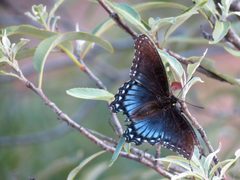
Limenitis arthemis arizonensis is a of the red-spotted purple complex found in western North America. It represents one of several stable hybrid wing patterns within the nominal L. arthemis, which has been extensively studied for its evolution of mimicry. The subspecies occurs from Arizona to southern California and Mexico, overlapping with the range of the white admiral and red-spotted purple forms. Like other members of the complex, males are known to defend territories along riparian corridors.


Pronunciation
How to pronounce Limenitis arthemis arizonensis: /ˌlaɪməˈnaɪtɪs ˈɑrθɛmɪs ˌærɪˈzoʊnɛnsɪs/
These audio files are automatically generated. While they are not always 100% accurate, they are a good starting point.
Identification
Distinguished from the eastern red-spotted purple (L. a. astyanax) by geographic range and potentially by wing pattern details, though specific diagnostic characters for arizonensis are not well documented in available sources. The broader L. arthemis complex is characterized by hybridization between mimetic (red-spotted purple) and non-mimetic (white admiral) , with intermediate forms occurring in overlap zones.
Images
Habitat
Associated with riparian corridors and streamside vegetation in desert and semi-arid regions. Males defend territories that include plants for caterpillars.
Distribution
Southwestern United States and northern Mexico. Documented from Arizona, southern California, and Mexico. GBIF records also indicate presence in Alberta, Manitoba, and Saskatchewan, Canada, and Vermont, USA, though these may represent vagrant records or data entry errors requiring verification.
Diet
have been observed probing for salts on moist ground. Larvae feed on riparian trees and plants, though specific plants for this are not documented in available sources.
Behavior
Males defend territories along riparian corridors that include larval plants. engage in "puddling" , sipping from wet sand and soil to obtain minerals. When disturbed while puddling, individuals can be approached closely. Males engage in aerial combat with other males intruding on territories.
Similar Taxa
- Limenitis arthemis astyanaxEastern of the red-spotted purple; distinguished primarily by geographic range (eastern vs. southwestern North America), though wing pattern differences may exist.
- Limenitis arthemis arthemisThe white admiral form; non-mimetic with bold black and white wing bands, occurring in northern parts of the range where model species for mimicry are absent.
- Limenitis lorquiniAnother western admiral with similar size and preferences; distinguished by different wing pattern and lack of red spotting.
More Details
Mimicry Complex
The L. arthemis represents one of the most dramatic examples of hybridization between non-mimetic and mimetic in butterflies, with arizonensis occurring in the zone of overlap between forms.
Taxonomic History
Formerly considered a of Polistes exclamans by some authors, though this appears to be an error conflating this with a ; the butterfly subspecies was described by W.H. Edwards in 1882.
Sources and further reading
- BugGuide
- GBIF taxonomy match
- iNaturalist taxon
- NCBI Taxonomy
- Bug Eric: Wasp Wednesday: Polistes arizonensis
- Destination Sonoran Desert: A time to sting for the Giant Hairy Desert Scorpion, 'Hadrurus arizonensis' — Bug of the Week
- Botanizing at Creve Coeur Lake | Beetles In The Bush
- Bug Eric: Mother (Nature's) Day in Madera Canyon
- Plantae | Beetles In The Bush | Page 7
- Missouri | Beetles In The Bush | Page 5