
Limenitis archippus obsoleta
Edwards, 1882
Southwest Viceroy
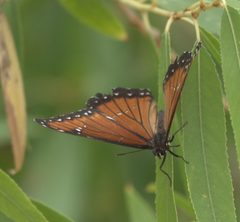
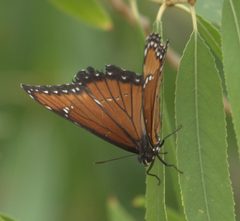
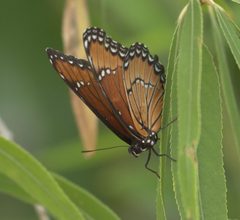
Limenitis archippus obsoleta, commonly known as the Southwest Viceroy, is a of viceroy native to western North America. Unlike the nominate eastern subspecies, this form exhibits darker, more brownish-purple coloration and is thought to mimic the Queen butterfly (Danaus gilippus) rather than the Monarch. The subspecies demonstrates the geographic variation in mimicry systems, where different models drive selection in different regions.
Pronunciation
How to pronounce Limenitis archippus obsoleta: //lɪˈmɛnɪtɪs ɑːrˈkɪpəs ˌɒbsəˈliːtə//
These audio files are automatically generated. While they are not always 100% accurate, they are a good starting point.
Identification
The submarginal semi-circular black line across the hindwing distinguishes viceroys from monarchs. Southwest Viceroy (L. a. obsoleta) differs from the nominate eastern by its darker, brownish-purple coloration rather than bright orange. Males patrol territories and perch frequently, a not reliably seen in monarchs. In Arizona and the Southwest, this subspecies resembles the Queen butterfly more than the Monarch.
Images
Distribution
Western North America, including Arizona and the southwestern United States. Records from Alberta, Manitoba, and Saskatchewan in Canada.
Behavior
Males are territorial, patrolling and perching frequently within their territories. This behavioral trait contrasts with monarchs, which do not exhibit dependable territorial perching.
Similar Taxa
- Limenitis archippus archippusEastern nominate with bright orange coloration mimicking the Monarch; L. a. obsoleta is darker and more brownish-purple
- Danaus plexippusMonarch butterfly; viceroys were long considered Batesian mimics but are now recognized as Müllerian co-mimics with their own chemical defenses
- Danaus gilippusQueen butterfly; the primary model for mimicry by L. a. obsoleta in the southwestern United States
Sources and further reading
- BugGuide
- GBIF taxonomy match
- iNaturalist taxon
- NCBI Taxonomy
- Catalogue of Life
- 'Fourteen' Is a Lucky Number: That's Where the Monarchs Are | Bug Squad
- 'Eyes on the Butterflies' at the Bohart Museum of Entomology | Bug Squad
- The Monarchs at the Bohart Museum of Entomology | Bug Squad
- Bug Eric: Bosque del Apache National Wildlife Refuge
- The Growing Utility of Online Photo Sharing for Entomology Research
- Bug Eric: January 2016