
Speyeria idalia
(Drury, 1773)
regal fritillary
idalia, commonly known as the regal fritillary, is a prairie-obligate native to North America. The species has experienced severe declines, with abundance and occupied range reduced by over 99% due to tallgrass prairie loss and degradation. Populations are now largely restricted to isolated remnant prairie patches, primarily in the Flint Hills ecoregion of Kansas and scattered sites across the Midwest. The species is under consideration for protection under the Act and serves as an indicator for grassland health.
Pronunciation
How to pronounce Speyeria idalia: //ˈspaɪəriə aɪˈdeɪliə//
These audio files are automatically generated. While they are not always 100% accurate, they are a good starting point.
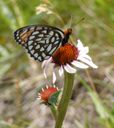
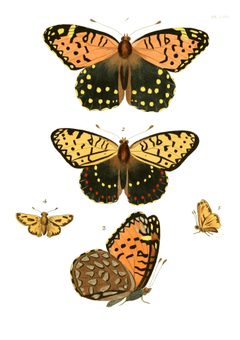
Images
Habitat
Tallgrass prairie ; specifically prairie-obligate requiring native grassland . respond positively to moderate fire-return intervals and severe disturbance regimes that maintain larval plants. Habitat quality is strongly influenced by grass cover (positive association) and negatively affected by woody vegetation encroachment. Sites with ≤15 ha of suitable grassland often result in undetectable populations.
Distribution
North America; historically widespread across the tallgrass prairie region from southern Canada to the central United States. Current range severely contracted with core in the Flint Hills ecoregion of Kansas (largest remaining contiguous tallgrass prairie tract). Remnant populations in Wisconsin, Pennsylvania, Nebraska, Illinois, Indiana, and scattered sites in Manitoba and Saskatchewan, Canada. Eastern populations genetically isolated from western populations.
Diet
Larvae feed on Viola (violets) as obligate plants. nectar on milkweeds (Asclepias) and thistles (Cirsium), with nectar sources favoring wetter sites within prairie .
Host Associations
- Viola spp. - larval plant (obligate)Females lay on or near violet clumps; larvae feed on fresh leaves after spring from hibernation
- Viola bicolor - larval plantPrimary plant identified at restoration sites in NW Indiana/NE Illinois
- Viola sagittata - larval plantDocumented at Fort Indiantown Gap, Pennsylvania
- Asclepias spp. - nectar sourceGrows best on wetter sites after disturbance
- Cirsium spp. - nectar sourceThistles provide nectar resources
Life Cycle
Females lay in late summer (August–September) on or near violet plants. Eggs hatch into larvae that crawl to nearby violets, hide among fallen leaves, and enter hibernation without feeding. Larvae resume feeding on fresh violet leaves in spring, complete development through summer, and form chrysalises before . Males typically emerge slightly before females in early summer. Adults are long-lived for butterflies, with females often surviving into October.
Behavior
Strong and fast flyers capable of dispersing across fragmented landscapes. Navigation to suitable occurs primarily through visual perception; experimental flash-blinding eliminates habitat-finding ability even at short distances. exhibit metapopulation dynamics with source-sink structures, responding positively to habitat restoration by expanding into and colonizing previously unoccupied habitats. Sex-biased recapture rates complicate population size estimation.
Ecological Role
for tallgrass prairie health and restoration success. -restricted member of grassland and oak barrens insect . Serves as a model for studying landscape- genetic effects of habitat fragmentation in high species.
Human Relevance
Subject of intensive conservation efforts including restoration, prescribed fire management, and long-term monitoring programs. Considered for protection under the Act due to severe declines. Used in research on navigation, metapopulation dynamics, and genetic effects of habitat fragmentation. Military training activities at Fort Indiantown Gap, Pennsylvania inadvertently maintain suitable habitat through severe soil and vegetation disturbance.
Similar Taxa
- Speyeria cybeleSimilar orange and black coloration; distinguished by S. idalia's more restricted prairie requirement and larger size with distinct wing spotting pattern
- Speyeria atlantisOverlapping range and similar use; S. idalia distinguished by prairie-obligate versus more habitat associations of S. atlantis
Sources and further reading
- BugGuide
- GBIF taxonomy match
- Catalogue of Life
- UC Davis Seminar: 'Insect Conservation in an Uncertain Future' | Bug Squad
- Bohart Museum Butterfly Donor Chuck Hageman Leaves a Lasting Legacy | Bug Squad
- Two other orange and black butterflies: Variegated fritillary, Euptoieta claudia, and great spangled fritillary, Speyeria cybele — Bug of the Week
- Speyeria atlantis Archives - Entomology Today
- The Eyes Have It: How Butterflies Navigate to Suitable Habitat
- USPS Issues Butterfly Postage Stamp
- Management regime and habitat response influence abundance of regal fritillary (Speyeria idalia) in tallgrass prairie
- The Role of Disturbance in Habitat Restoration and Management for the Eastern Regal Fritillary (Speyeria idalia idalia) at a Military Installation in Pennsylvania
- Landscape-scale response to local habitat restoration in the regal fritillary butterfly (Speyeria idalia) (Lepidoptera: Nymphalidae)
- Oviposition Site Selection by the Regal Fritillary, Speyeria idalia, as Affected by Proximity of Violet Host Plants
- Landscape scale genetic effects of habitat fragmentation on a high gene flow species: Speyeria idalia (Nymphalidae)
- Complex Messages in Long-Term Monitoring of Regal Fritillary (Speyeria idalia) (Lepidoptera: Nymphalidae) in the State of Wisconsin, USA, 1988–2015
- Measuring Regal Fritillary Butterfly (Speyeria idalia) Habitat Requirements in South-Central Pennsylvania: Implications for the Conservation of an Imperiled Butterfly
- Novel Observations of Larval Fire Survival, Feeding Behavior, and Host Plant Use in the Regal Fritillary,Speyeria idalia(Drury) (Nymphalidae)
- Sex-biased recapture rates present challenges to quantifying population sizes and dispersal behavior of the regal fritillary butterfly (Speyeria idalia)
- A descriptive analysis of Regal Fritillary (Speyeria idalia) habitat utilizing biological monitoring data along the big bend of the Platte River, NE