
Boloria frigga
(Thunberg, 1791)
Frigga Fritillary
Boloria frigga is a circumboreal fritillary distributed across northern bogs and tundra . The exhibits a , producing one every two years. Larvae feed on specific bog plants including cloudberry (Rubus chamaemorus) and small cranberry (Vaccinium oxycoccos). The species name derives from Frigg, a goddess in Norse mythology.
Pronunciation
How to pronounce Boloria frigga: /bɔˈloʊriə ˈfrɪɡə/
These audio files are automatically generated. While they are not always 100% accurate, they are a good starting point.
Identification
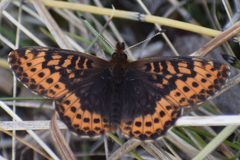
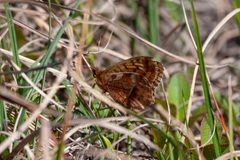
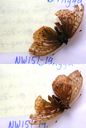
Distinguished from similar fritillaries by the characteristic under surface pattern: broad cinnamon forewing margin and relatively unmarked hindwing with only slight contrast between pale margin and cinnamon base. The straight, margin-parallel black markings on the upper surface also aid identification. Most similar to other Boloria , but the specific wing pattern elements are diagnostic.
Images
Appearance
Above pale reddish yellow with black markings in central and marginal areas; markings are very straight and parallel with the margin. Forewing under surface has a broad cinnamon margin. Hindwing under surface is but little variegated, with a paler distal margin contrasting with the cinnamon basal area. band on under surface dusted with cinnamon and only slightly prominent, with an irregularly rhomboidal pale spot before the middle of the being conspicuous.
Habitat
Occurs in bogs and tundra, specifically willow and sphagnum bogs. Found in Arctic and subarctic regions, typically north of 60° N in Europe. characterized by presence of larval plants in wetland conditions.
Distribution
Circumboreal distribution: Northern Europe (north of 60° N, with very local southern occurrences), Urals, Siberia, Northern Mongolia, Russian Far East, western United States and Canada. Recently recorded from Kolguev Island in Arctic Russia.
Diet
Larvae feed on Rubus chamaemorus (cloudberry), Vaccinium oxycoccos (small cranberry), and occasionally Vaccinium uliginosum (bog bilberry). In experimental conditions, larvae have been observed to accept Polygonum viviparum and Rubus fruticosus.
Host Associations
- Rubus chamaemorus - larval plantprimary
- Vaccinium oxycoccos - larval plantprimary
- Vaccinium uliginosum - larval plantoccasional
- Polygonum viviparum - experimental acceptanceaccepted in laboratory conditions, not confirmed as natural
- Rubus fruticosus - experimental acceptanceaccepted in laboratory conditions, not confirmed as natural
Life Cycle
Produces one every two years ( ). Specific details of , larval, pupal, and stages are not documented in available sources.
Similar Taxa
- Boloria seleneSimilar size and general fritillary appearance; distinguished by wing pattern details, particularly the more variegated under surface and different marginal banding patterns. B. selene has more prominent silver markings on hindwing underside.
- Other Boloria speciesShare general fritillary and bog-dwelling habits; require careful examination of under surface wing pattern for accurate identification, particularly the cinnamon marginal band and rhomboidal spot characteristic of B. frigga.
More Details
Etymology
The specific epithet 'frigga' refers to Frigg, a goddess in Norse mythology.
Conservation notes
occurs in specialized bog and tundra that are vulnerable to climate change and drainage. The may make more sensitive to environmental disturbances in consecutive years.
Sources and further reading
- BugGuide
- Wikipedia
- GBIF taxonomy match
- iNaturalist taxon
- NCBI Taxonomy
- Funding from ScottishPower Foundation helps to restore vital habitat to encourage thriving natural ecosystem - Buglife Blog - Buglife
- Do Managed Burns in Grasslands Benefit Butterflies?
- An Evening at Silent Valley - Buglife Blog - Buglife
- The first record of Boloria frigga (Lepidoptera: Nymphalidae) on Kolguev Island, Arctic Russia