
Boloria astarte
(E.Doubleday, 1847)
Astarte Fritillary
Boloria astarte, commonly known as the Astarte fritillary, is a in the Nymphalidae. It has a broad distribution across northwestern North America and northeastern Siberia. The species exhibits a wingspan of 42–51 mm and is active from mid-June to mid-August. Its larvae feed exclusively on spotted saxifrage (Saxifraga bronchialis).
Pronunciation
How to pronounce Boloria astarte: /bɔˈlɔːrɪə əˈstɑːrti/
These audio files are automatically generated. While they are not always 100% accurate, they are a good starting point.
Identification
The Astarte fritillary can be distinguished from other North American fritillaries by its geographic distribution, extending into northeastern Siberia and occurring at more northern latitudes than most . The specific larval plant, spotted saxifrage (Saxifraga bronchialis), may aid in identification where this plant occurs. B. a. astarte occurs in northern British Columbia, while B. a. distincta is found in Alaska, Yukon, and Northwest Territories.
Images
Appearance
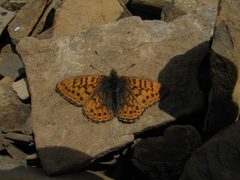
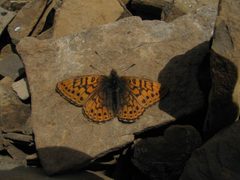
Wingspan ranges from 42–51 mm. As a fritillary , it likely exhibits the characteristic orange-brown wing coloration with dark markings typical of the Boloria, though specific pattern details are not provided in available sources.
Habitat
Inferred to be associated with the of its larval plant, spotted saxifrage, which typically grows in rocky, mountainous environments. The has been documented in montane regions of Montana and Washington at the southern extent of its range.
Distribution
Northwestern North America to northeastern Siberia. In North America, occurs from Alaska, Yukon, and Northwest Territories south to northern British Columbia, Montana, and Washington.
Seasonality
period from mid-June to mid-August.
Diet
Larvae feed exclusively on spotted saxifrage (Saxifraga bronchialis). feeding habits are not documented in available sources.
Host Associations
- Saxifraga bronchialis - larval plantspotted saxifrage; exclusive larval food source
Life Cycle
Complete typical of Lepidoptera. Specific details of , larval instars, , and stage are not documented in available sources.
Similar Taxa
- Boloria seleneSimilar (pearl-bordered fritillaries), but B. selene occurs in Europe and has been introduced to North America in limited areas; differs in distribution and likely plant associations
- Other Boloria speciesMost North American Boloria have more southerly distributions and different larval plant preferences
More Details
Taxonomic note
GBIF lists Boloria astarte as a synonym of Clossiana astarte, reflecting historical taxonomic debate about generic placement within the fritillary butterflies. NCBI and most modern sources maintain Boloria as the accepted .
Subspecies
Two recognized: Boloria astarte astarte (northern British Columbia) and Boloria astarte distincta (Alaska, Yukon, Northwest Territories).
Sources and further reading
- BugGuide
- Wikipedia
- GBIF taxonomy match
- iNaturalist taxon
- NCBI Taxonomy
- Bug Eric: Wasp Wednesday: Ammophila procera
- Funding from ScottishPower Foundation helps to restore vital habitat to encourage thriving natural ecosystem - Buglife Blog - Buglife
- Do Managed Burns in Grasslands Benefit Butterflies?
- Bug Eric: November 2010
- Bug Eric: 2010
- An Evening at Silent Valley - Buglife Blog - Buglife