
Greta morgane
(Geyer, 1833)
thick-tipped greta
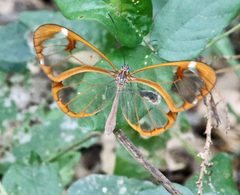
Greta morgane, commonly known as the thick-tipped greta, is a day-active clearwing in the Nymphalidae. have reduced wing scaling that creates transparent areas on the wings, a characteristic feature of ithomiine butterflies. The is widespread and common across its native range in Mexico, Central America, and the Caribbean, with occasional strays recorded in southern Texas. It was first described by Geyer in 1833 under the basionym Hymenitis morgane.


Pronunciation
How to pronounce Greta morgane: /ˈɡreːta mɔrˈɡaːne/
These audio files are automatically generated. While they are not always 100% accurate, they are a good starting point.
Identification
Distinguished from other Greta by the thickened wing tips referenced in its . The combination of clearwing (transparent wing areas with reduced scaling), ithomiine body shape, and geographic range helps separate it from similar clearwing butterflies in other such as Godyris or Ithomia. The dark wing borders and overall size are consistent with the genus Greta.
Images
Appearance
A clearwing with transparent wing areas created by reduced scaling. Wingspan ranges from 56 to 58 mm. The wing tips are thickened, giving rise to the . Like other ithomiine butterflies, it possesses a slender body and long, narrow wings relative to body size. Coloration includes dark borders on the wings with transparent central areas.
Habitat
Tropical and subtropical forested environments. Occurs in regions with adequate vegetation to support its larval plants and nectar sources. Specific microhabitat preferences within forests are not well documented.
Distribution
Native to Mexico, Central America (Middle America), and the Caribbean islands. Recorded as a vagrant in southern Texas, USA in 2004. The has a broad distribution across the Neotropical region and is considered common throughout its range.
Seasonality
are active during daylight hours year-round in tropical portions of the range; activity patterns in subtropical areas likely follow warmer months.
Behavior
activity pattern. are known to visit flowers for nectar. Like other ithomiine butterflies, males may engage in patrolling to locate females, though specific behavioral observations for this are limited.
Ecological Role
function as when visiting flowers. Larval is poorly known but likely involves herbivory on plants. The contributes to local biodiversity as a common member of the ithomiine in its range.
Human Relevance
Occasionally observed by enthusiasts and researchers. The 2004 Texas record represents a notable northward range extension of interest to lepidopterists. No significant economic or agricultural impact has been documented.
Similar Taxa
- Other Greta speciesShare clearwing and -level characteristics; distinguished by wing tip structure and specific wing pattern details
- Godyris butterfliesSimilar clearwing appearance in the same Danainae; differ in body proportions and wing venation patterns
- Ithomia speciesAnother ithomiine with transparent wings; separated by wing shape and pattern elements
More Details
Taxonomic History
Originally described as Hymenitis morgane by Geyer in 1833, later transferred to the Greta. The genus Greta currently contains multiple clearwing distributed across the Neotropics.
Conservation Status
Not evaluated by IUCN; given its wide distribution and reported commonness, the is not considered threatened.
Sources and further reading
- BugGuide
- Wikipedia
- GBIF taxonomy match
- iNaturalist taxon
- NCBI Taxonomy
- Catalogue of Life
- environement | Blog
- Pensoft Editorial Team | Blog - Part 53
- Moth collected by Alfred Russel Wallace is key to describing 11 new species
- Top new species discoveries for the first half of 2022
- A decade of empowering biodiversity science: celebrating 10 years of Biodiversity Data Journal |
- Gastropoda | Blog