
Marpesia chiron
(Fabricius, 1775)
many-banded daggerwing
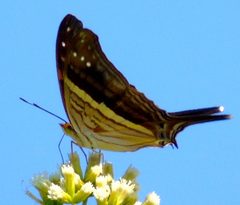
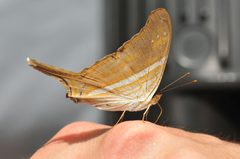
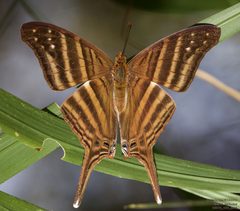
Marpesia chiron, commonly known as the many-banded daggerwing, is a in the Nymphalidae. It belongs to the daggerwings or map butterflies, a group characterized by angular wing margins and distinctive patterns. The species occurs across a broad geographic range spanning Central America, North America, and South America. Two are recognized: M. c. chiron and M. c. insularis.
Pronunciation
How to pronounce Marpesia chiron: /mɑrˈpe.si.ə ˈkaɪ.rɒn/
These audio files are automatically generated. While they are not always 100% accurate, they are a good starting point.
Identification
The many-banded daggerwing can be distinguished from other daggerwing (Marpesia spp.) by its characteristic wing banding pattern. As the suggests, multiple bands are present on the wings. The angular, dagger-like wing margins typical of the Marpesia help separate it from other Nymphalidae. The M. c. insularis was described by Fruhstorfer and differs in distribution and presumably in wing pattern details from the nominate subspecies.
Images
Distribution
Found in Central America, North America, and South America. Specific localities with confirmed records include: El Playón, Floridablanca, and Piedecuesta in Colombia; Leticia and Villavicencio (Vereda Barcelona, Universidad de los Llanos, Km 12 vía que conduce a Puerto López-Meta) in Colombia; Turbaco and Jardín Botánico de Cartagena Guillermo Piñeres in Bolívar, Colombia; and Parque Nacional Natural Serranía de Chiribiquete (PNNSCh) in Colombia.
Behavior
have been observed engaging in "pumping" on tropical beaches, where they appear to cool off by repeatedly opening and closing their wings while in contact with moist sand or surfaces.
Similar Taxa
- Other Marpesia speciesShare the characteristic angular, dagger-like wing margins and general body plan, but differ in wing pattern details such as number and arrangement of bands.
More Details
Taxonomic History
Originally described as Papilio chiron by Fabricius in 1775, later transferred to the Marpesia.
Subspecies
Two recognized: Marpesia chiron chiron (nominate subspecies) and Marpesia chiron insularis Fruhstorfer.
Cataloging Information
The has been assigned MONA/Hodges number 4549 in North American lepidopteran catalogs.
Sources and further reading
- BugGuide
- Wikipedia
- GBIF taxonomy match
- iNaturalist taxon
- NCBI Taxonomy
- Catalogue of Life
- Chironomidae | Beetles In The Bush
- Bug of the Week Academy Awards 2018 — Bug of the Week
- What Can Insects and Mites Tell Us About Water Quality?
- cytogenetics | Blog
- Eocene | Beetles In The Bush
- Itty bitty tiny little flies | Beetles In The Bush