
Biblis
Fabricius, 1807
red rim, crimson-banded black
Species Guides
1- Biblis hyperia(red rim)
Biblis is a of brush-footed butterflies in the Nymphalidae, established by Fabricius in 1807. The sole , Biblis hyperia, is commonly known as the red rim or crimson-banded black. This is distributed across the Americas from the southern United States through Central America to South America.
Pronunciation
How to pronounce Biblis: /ˈbɪblɪs/
These audio files are automatically generated. While they are not always 100% accurate, they are a good starting point.
Identification
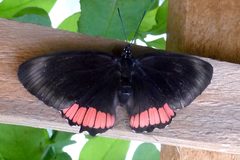
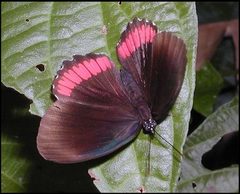
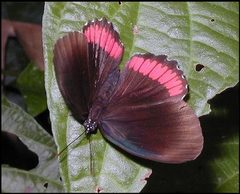
The combination of black wings with a continuous crimson or red band along the outer margins distinguishes Biblis hyperia from similar black butterflies in its range. The band is present on both forewings and hindwings. The reduced front legs, held close to the body and not used for , confirm -level placement in Nymphalidae.
Images
Appearance
Biblis hyperia has black wings with a distinctive crimson or red band along the outer margins of both forewings and hindwings. The undersides are cryptically patterned with brown and gray tones. As a member of Nymphalidae, it has reduced, brush-like front legs that are not used for .
Habitat
Tropical and subtropical regions including forest edges, open woodlands, and disturbed areas. Specific microhabitat preferences are not documented in available sources.
Distribution
Native to the lower Rio Grande Valley of Texas, United States; Mexico; the Caribbean; Central America; and South America south to Paraguay.
Diet
feed on nectar. Larval plants are not documented in provided sources.
Life Cycle
Complete with , larva, pupa, and stages. Specific details of developmental duration and of stages are not available in provided sources.
Ecological Role
function as when feeding on nectar. Specific interactions are not documented in available sources.
Human Relevance
Occasionally observed by enthusiasts in the southern United States. Not known to be of agricultural or economic significance.
Similar Taxa
- Other Nymphalidae with red marginal bandsSeveral nymphalid (e.g., some Hamadryas, Diaethria) have red or orange wing markings, but Biblis hyperia is distinguished by the specific pattern of a continuous crimson band on an otherwise uniformly black wing surface
- Melanis and related RiodinidaeSome metalmark butterflies have similar dark coloration with marginal markings, but differ in wing shape and lack the reduced forelegs characteristic of Nymphalidae
More Details
Taxonomic status
The Biblis is , containing only the single Biblis hyperia. The genus was established by Johan Christian Fabricius in 1807.
Etymology note
The name Biblis is unrelated to the German municipality of Biblis in Hesse, which derives from a Celtic or Germanic root meaning 'settlement at the water.' The genus name likely has a different etymological origin, possibly from Greek mythology (Biblis/Biblis was a figure in classical mythology), though the exact derivation is not documented in provided sources.