
Biblis hyperia
(Cramer, 1779)
red rim, crimson-banded black, Southern Red Rim
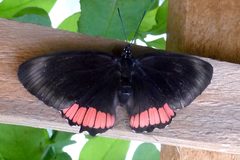
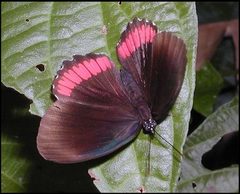
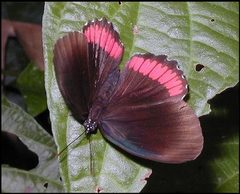
Biblis hyperia is a ( Nymphalidae) and the sole member of its . display striking velvety-black forewings contrasted with gray hindwings bearing a distinctive pinkish-red marginal band. The occurs from the southern United States through the Neotropics to Paraguay, with activity recorded primarily between March and November. Larvae feed on the spurge family vine Tragia volubilis.
Pronunciation
How to pronounce Biblis hyperia: /ˈbɪblɪs haɪˈpɪriə/
These audio files are automatically generated. While they are not always 100% accurate, they are a good starting point.
Identification
The combination of velvety-black forewings, gray hindwings, and the diagnostic pinkish-red marginal band on the hindwing separates this from superficially similar black butterflies in its range. The red rim is continuous and relatively broad, not broken into spots or marginal dots.
Images
Habitat
Subtropical forest; specific microhabitat preferences within forest structure are not well documented
Distribution
Lower Rio Grande Valley of Texas (United States), Mexico, the Caribbean, Central America, and South America south to Paraguay
Seasonality
active March through November in observed range; peak activity timing varies geographically
Diet
Larvae feed on Tragia volubilis (Euphorbiaceae); feeding habits not documented
Host Associations
- Tragia volubilis - larval plantEuphorbiaceae vine
Life Cycle
Complete with documented larval stage; specific details of , pupal stages, and time not available
Similar Taxa
- Other Nymphalidae with black wings and red markingsMay share general color pattern but lack the specific combination of velvety-black forewings, gray hindwings, and continuous pinkish-red hindwing marginal band
More Details
Taxonomic notes
Biblis is currently , though at least one undescribed species is suspected to exist in Peru.
Subspecies
Five described : B. h. aganisa, B. h. hyperia, B. h. laticlavia, B. h. nectanabis, and B. h. pacifica; plus an unnamed form from Peru.
GBIF taxonomic status
GBIF flags this name as DOUBTFUL and incorrectly assigns it to Sesiidae (clearwing moths); this appears to be a database error as all authoritative sources place it in Nymphalidae.