
Hamadryas februa
(Hübner, 1823)
Gray Cracker, Grey Cracker
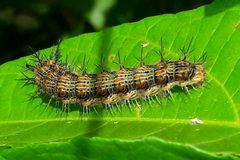
Hamadryas februa is a cracker (Nymphalidae) ranging from Argentina through tropical America to Mexico, with rare strays reaching southern Texas. feed on sap and rotting fruit, while larvae specialize on Dalechampia and Tragia (Euphorbiaceae). The species exhibits pronounced in -related , with females being larger and more dispersive than males. Development from to adult takes approximately 33–34 days under laboratory conditions.
Pronunciation
How to pronounce Hamadryas februa: /ˌhæm.əˈdraɪ.əs ˈfɛb.ruː.ə/
These audio files are automatically generated. While they are not always 100% accurate, they are a good starting point.
Identification
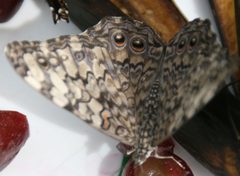
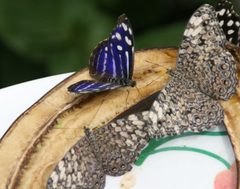
are distinguished by wingspan of 70–86 mm and gray coloration typical of 'cracker' butterflies in Hamadryas. Males and females differ in size: females possess larger , greater total wing area, and higher wing loading. The produces characteristic cracking sounds during —a trait shared with but not unique to this species. Separation from other Hamadryas species requires examination of wing pattern details and genitalia.
Images
Habitat
Subtropical forests, forest edges, and cultivated areas with trees. In Rica, occurs in semi-deciduous lowland forests where larval plant Dalechampia heteromorpha grows in shady places along forest edges. Host plant patches are small and widely separated, creating a fragmented resource distribution.
Distribution
Argentina north through tropical America to Mexico. Rare strays documented in lower Rio Grande Valley, southern Texas. H. f. februa occurs in Brazil, Paraguay, and Peru; H. f. ferentina ranges from southern Texas and Mexico through Honduras to Trinidad.
Seasonality
are on wing year-round in tropical portions of range. In southern Texas, active from August to October.
Diet
feed on sap and rotting fruit. Larvae feed on Dalechampia (including D. heteromorpha) and Tragia species (Euphorbiaceae).
Host Associations
- Dalechampia heteromorpha - larval plantSmall herbaceous vine used for oviposition and larval development
- Dalechampia species - larval plantGeneral
- Tragia species - larval plantAdditional
Life Cycle
Complete with , larva, pupa, and stages. Development time 33–34 days when reared on Dalechampia heteromorpha in laboratory conditions. Multiple per year maintained in Guanacaste, Rica due to year-round availability of lush plant vegetation even during dry season.
Behavior
rest on tree trunks; specific trees used for resting have been documented relative to plant locations. Larvae feed on host plant vegetative structures. Females are more dispersive than males based on . amount affects body mass allocation: both sexes increase mass with decreasing habitat amount, with females showing more pronounced response including increased total mass and wing loading while decreasing thorax allocation.
Ecological Role
Herbivore in larval stage; serves as frugivore and sap-feeder. Part of complex in neotropical forest . plant Dalechampia heteromorpha supports multiple herbivorous insect , indicating shared resource use in forest edge .
Similar Taxa
- Hamadryas feroniaCongeneric cracker with overlapping range; requires wing pattern and genital examination for separation
- Hamadryas glauconomeSimilar gray coloration and cracking sound production; distinguished by specific wing markings
Sources and further reading
- BugGuide
- Wikipedia
- GBIF taxonomy match
- iNaturalist taxon
- NCBI Taxonomy
- Catalogue of Life
- Bug Eric: February 2009
- Bug Eric: February 2024
- Bug Eric: February 2020
- Bug Eric: February 2010
- Bug Eric: February 2017
- Grow Your Own: Eating and gardening through the seasons - Buglife Blog - Buglife
- On the biology of Hamadryas februa (Lepidoptera: Nymphalidae) in Guanacaste, Costa Rica
- The effect of habitat amount on flight‐related traits in the butterfly Hamadryas februa is sex‐dependent