
Hamadryas feronia
(Linnaeus, 1758)
Variable Cracker, Blue Cracker
Hamadryas feronia, commonly known as the variable cracker or blue cracker, is a neotropical in the Nymphalidae. It is notable for producing loud clicking sounds during , a trait that gives the 'cracker' butterflies their . The exhibits bark-mimicking camouflage and complex between males. Two are recognized: H. feronia feronia in South America and H. feronia farinulenta in Central America and Mexico.
Pronunciation
How to pronounce Hamadryas feronia: /ˌhæmədˈraɪəs fəˈroʊniə/
These audio files are automatically generated. While they are not always 100% accurate, they are a good starting point.
Identification
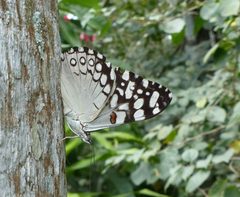
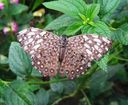
Distinguished from Hamadryas guatemalena and Hamadryas iphthime by the specific arrangement of eyespots and the red bar in the of the forewing. The combination of mosaic grey-brown-blue upperside pattern with marginal eyespots and bark-mimicking underside is characteristic. Acoustic clicking during is diagnostic for the but not -specific within Hamadryas. H. feronia farinulenta differs from nominate H. feronia feronia in geographic distribution and subtle wing pattern differences.
Images
Habitat
Found in open areas with trees, including forest edges, clearings, and riverine vegetation. In the Peruvian Amazon, occurs in tropical lowland rainforest along river systems. Perches predominantly on tree trunks where bark-mimicking coloration provides camouflage.
Distribution
Neotropical. Two : H. feronia feronia in Brazil, Paraguay, and Peru; H. feronia farinulenta in Mexico, Honduras, Venezuela, Colombia, and Trinidad. Northern limit in southern United States (as stray or resident in southern Texas); southern limit in Brazil.
Seasonality
In Mexico, fly year-round with peak abundance June through September. In Peruvian Amazon, active on sunny days with activity recorded January through December.
Diet
Larvae feed on leaves of Dalechampia triphylla (South America) and D. juruana (Peru), vines in Euphorbiaceae. feed on rotting fruit, and have been observed feeding on bark sap of Cedrela odorata, Spondias mombin, and Uncaria guianensis, plus fermented fruits of Syzygium malaccense and Pouteria caimito.
Host Associations
- Dalechampia triphylla - larval plantPrimary in South America
- Dalechampia juruana - larval plantDocumented in Peruvian Amazon
- Cedrela odorata - food sourceBark sap feeding
- Spondias mombin - food sourceBark sap feeding
- Uncaria guianensis - food sourceBark sap feeding
- Syzygium malaccense - food sourceFermented fruit feeding
- Pouteria caimito - food sourceFermented fruit feeding
Life Cycle
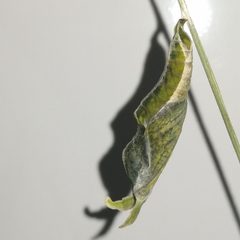
Complete with five larval instars. Total development from to averages 28.2 days under laboratory conditions in Peru: egg stage 3.8 days; larval instars 3.2, 2.8, 2.7, 3.2, and 4.6 days respectively; 1.3 days; pupa 6.7 days. Adults emerge mid-morning (10:00–11:00 h). Adult lifespan averages 31.8 days for males and 42.0 days for females in captivity. Eggs deposited singly on upper and lower leaf surfaces, more frequently on undersides.
Behavior
Males perch -down on tree trunks, taking when conspecifics approach. During chase, males produce loud clicking sounds (approximately 80–100 dB SPL at 10 cm) via modified forewing that buckle during the wing upstroke; clicks are brief (2–3 ms) double-component sounds with peak energy at 13–15 kHz. Approaching males respond with their own clicks; females remain silent. Males prefer white perching substrates; females prefer grey. active on sunny days. Females exhibit irregular flight around plants prior to oviposition (08:00–14:00 h).
Ecological Role
Larval herbivore on Euphorbiaceae vines. frugivore that may contribute to nutrient cycling through consumption of rotting fruit. parasitized by microhymenopterans ( Scelionidae), which may regulate size. suggests role in and mate location.
Human Relevance
Identified as having potential for biotrade including export, handicrafts, and tourist breeding centers in the Peruvian Amazon. Subject of scientific interest due to unique system. Featured in educational materials about .
Similar Taxa
- Hamadryas guatemalenaSimilar wing pattern and coloration; distinguished by specific eyespot arrangement and markings
- Hamadryas iphthimeOverlapping range and bark-mimicking appearance; separated by forewing pattern details
More Details
Acoustic Mechanism
Sound production involves modified forewing subcostal and cubital that buckle elastically when wings close during the upstroke. This contradicts earlier hypotheses of percussive mechanisms involving wing-to-wing or wing-to-body contact. Single-wing sound production has been demonstrated.
Hearing Organ
Possesses Vogel's organ at the base of the forewing subcostal and cubital —a true tympanal ear with thinned exoskeletal , rigid chitinous ring, and three . The largest contains over 110 scolopidial units. Best hearing sensitivity at 1.75 kHz (threshold 68 dB SPL), which is lower than the 13–15 kHz peak energy of produced clicks, but sufficient for detection at close interaction distances (<30 cm) due to broad frequency spectrum of clicks.
Perching Substrate Preference
Experimental evidence shows in perch color preference: males prefer white substrates, females prefer grey. This may relate to sex-specific camouflage optimization or thermoregulatory differences.
Sources and further reading
- BugGuide
- Wikipedia
- GBIF taxonomy match
- iNaturalist taxon
- NCBI Taxonomy
- Catalogue of Life
- Rosemary Mosco: Butterflies Are Pretty, But They Can Be 'Pretty Gross' | Bug Squad
- Sound Production and Hearing in the Blue Cracker Butterfly Hamadryas Feronia (Lepidoptera, Nymphalidae) From Venezuela
- Alimentación, comportamiento de oviposición, ciclo de vida y enemigos naturales de Hamadryas feronia (Nymphalidae) en la Amazonía del Perú