
Hamadryas guatemalena
(Bates, 1864)
Guatemalan cracker, Guatemalan calico
Hamadryas guatemalena, commonly known as the Guatemalan cracker or Guatemalan calico, is a medium-to-large in the Nymphalidae. It ranges from southern North America through Central America to central South America. exhibit year-round in tropical regions and peak activity in August in temperate areas. The is notable for its cracker-like wing patterns and carrion-feeding .

Pronunciation
How to pronounce Hamadryas guatemalena: /ˌhæməˈdraɪəs ˌɡwɑtəməˈleɪnə/
These audio files are automatically generated. While they are not always 100% accurate, they are a good starting point.
Identification
Distinguished from by the combination of geographic range (extending farther north than most South American Hamadryas) and specific wing pattern elements: broad white bands on forewings and hindwings with irregular orange-brown patches. Hamadryas amphinome (red cracker) has more extensive red coloration and different banding pattern. Hamadryas feronia lacks the distinct white median bands. The 'cracker' refers to the audible clicking sound produced by males when defending territories, a trait shared with other Hamadryas but not diagnostic to species level.
Images
Appearance
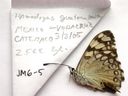
Wingspan 76–98 mm. wing surfaces display intricate black, white, and orange-brown calico patterning characteristic of the Hamadryas. The cryptic underside resembles dead leaves when wings are closed. Males and females are similar in general appearance, with males typically showing more prominent pale patches on the forewings.
Habitat
Tropical and subtropical forests, forest edges, and clearings. frequently encountered along trails, riverbanks, and in gaps where rotting fruit accumulates. Larval tied to plant distribution within Euphorbiaceae in forest understories.
Distribution
From southern North America (southern Texas, Mexico) through Central America to central South America. Records indicate presence throughout Mesoamerica and into northern South America, with northern limit in the Rio Grande Valley of Texas where it occurs as a resident or seasonal immigrant.
Seasonality
Year-round in tropical portions of range. In temperate zones (southern Texas), peak activity occurs in August. No evidence of migratory ; likely multi-brooded with continuous in favorable climates.
Diet
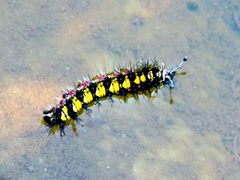
Larvae feed on of Euphorbiaceae (spurge ). feed on juices from rotting fruit and animal faeces; also observed at sap flows and carrion.
Host Associations
- Euphorbiaceae - larval Specific plant not documented in available sources
Life Cycle
Complete with four stages: , larva (caterpillar), pupa (chrysalis), and . No specific details on egg or pupal , or developmental duration, have been documented in available sources. presumably similar to other Hamadryas with solitary larvae feeding on plant leaves.
Behavior
Males produce audible clicking sounds by clapping wings together, used in territorial disputes and courtship. are strong, fast fliers that typically perch on tree trunks with wings closed, relying on cryptic underside coloration for camouflage. Frequently observed in at rotting fruit and other food sources.
Ecological Role
contribute to nutrient cycling through consumption and of decaying organic matter. Larvae function as herbivores on Euphorbiaceae. Serves as prey for birds, reptiles, and . Potential of limited significance given carrion-feeding habits.
Human Relevance
Occasional attraction to gardens and fruit-baited traps used by researchers and enthusiasts. Not considered an agricultural pest. Featured in educational materials about butterfly natural history, particularly regarding 'gross' feeding habits that challenge popular perceptions of butterflies.
Similar Taxa
- Hamadryas amphinomeOverlapping range and similar size; distinguished by more extensive red-orange coloration on wings and different banding pattern
- Hamadryas feroniaSimilar size and pattern elements; lacks distinct white bands present in H. guatemalena
- Hamadryas iphthimeSimilar cryptic underside; pattern has more irregular spotting and reduced white banding
Misconceptions
The 'cracker' and associated clicking sometimes incorrectly assumed to be unique to this ; the sound production is shared across the Hamadryas and not diagnostic. Popular perception of butterflies as exclusively nectar-feeding is contradicted by this species' documented reliance on rotting fruit and animal faeces.
More Details
Etymology
Specific epithet 'guatemalena' refers to Guatemala, within the core range of the . Original description by Henry Walter Bates in 1864 based on specimens from this region.
Taxonomic history
Originally described as Ageronia guatemalena Bates, 1864; transferred to Hamadryas following revision of cracker classification. Basionym preserved in synonymy.