
Electrostrymon angelia
(Hewitson, 1874)
Fulvous Hairstreak
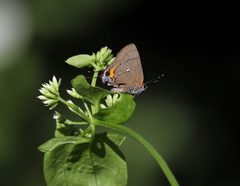
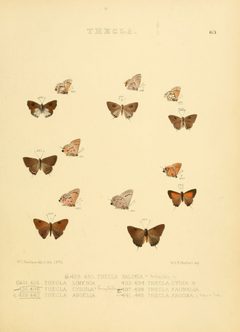
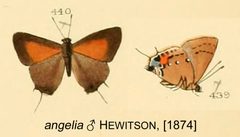
Electrostrymon angelia, commonly known as the fulvous , is a small in the Lycaenidae. It is found in North America and is assigned MONA/Hodges number 4352. The was originally described as Thecla angelia by Hewitson in 1874 and later transferred to the Electrostrymon. Four are recognized.
Pronunciation
How to pronounce Electrostrymon angelia: /ɛˌlɛktroʊˈstraɪmən ænˈdʒiːliə/
These audio files are automatically generated. While they are not always 100% accurate, they are a good starting point.
Identification
The is distinguished by its fulvous (tawny or yellowish-brown) coloration, characteristic of the 'fulvous ' . As a member of the hairstreak group within Lycaenidae, it likely bears the thin tail-like projections on the hindwings typical of the Theclinae, though specific diagnostic features are not documented in available sources. The MONA/Hodges number 4352 provides a standardized reference for North American Lepidoptera identification.
Images
Distribution
North America. Specific range details beyond continental distribution are not documented in available sources.
More Details
Nomenclature and Classification
The was originally described as Thecla angelia by William Chapman Hewitson in 1874. It has since been reclassified into the Electrostrymon. The GBIF match indicates the name Electrostrymon angelia is currently treated as a synonym of Thecla angelia in some databases, though NCBI and iNaturalist recognize Electrostrymon as the accepted genus.
Subspecies
Four are recognized: Electrostrymon angelia angelia (Hewitson, 1874), Electrostrymon angelia boyeri (Comstock & Huntington, 1943), Electrostrymon angelia dowi (authority not specified in source), and Electrostrymon angelia karukera Brévignon, 2000.