
Chlorostrymon telea
(Hewitson, 1868)
Telea Hairstreak
Chlorostrymon telea, commonly known as the telea , is a small in the Lycaenidae. It ranges from southern Texas and Mexico through Central America to South America, including Colombia, Uruguay, Paraguay, eastern Bolivia, Argentina, and Chile. have a wingspan of 16–22 mm and are active in June in southern Texas and from January to July in Central America.
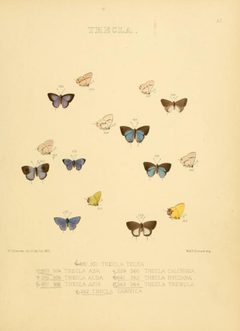
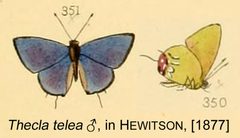
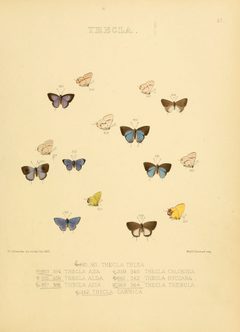
Pronunciation
How to pronounce Chlorostrymon telea: //ˌklɔːroʊˈstraɪmən ˈtɛliə//
These audio files are automatically generated. While they are not always 100% accurate, they are a good starting point.
Identification
Distinguished from other hairstreaks in the Chlorostrymon by geographic range and association with semideciduous dry forest stream valleys. Specific diagnostic features separating it from congenerics such as Chlorostrymon simaethis are not documented in available sources.
Images
Appearance
Small with wingspan of 16–22 mm. As a , likely possesses thin tail-like projections on the hindwings, though specific coloration and pattern details are not provided in available sources.
Habitat
Stream valleys within semideciduous dry forests. The association with riparian areas in otherwise arid forest environments appears consistent across its range.
Distribution
Southern Texas and Mexico south through Central America to Colombia, Uruguay, Paraguay, eastern Bolivia, Argentina, and Chile. Records include the Caribbean island of Providencia.
Seasonality
active in June in southern Texas; January to July in Central America. Seasonal patterns for South American are not documented.
Diet
feed on flower nectar. Larvae feed on flowers of Guazuma (Malvaceae) and Central American soapberry (Sapindus saponaria or related species).
Host Associations
- Guazuma - larval food plantflowers used
- Central American soapberry - larval food plantflowers used
Life Cycle
Complete with , larva, pupa, and stages. Larval development occurs on flowers of plants. Specific details of site and voltinism are not documented.
Ecological Role
function as while feeding on nectar. Larvae are herbivores that consume floral tissues of plants. Specific ecological interactions beyond these general roles are not documented.
Human Relevance
Subject of interest to enthusiasts and collectors. No documented economic or agricultural significance.
Similar Taxa
- Chlorostrymon simaethisCongeneric with overlapping range in parts of Central and South America; specific distinguishing characters require examination of wing pattern details not provided in general sources.
More Details
Taxonomic history
Originally described as Thecla telea by William Chapman Hewitson in 1868 before transfer to Chlorostrymon.
Observation frequency
Documented in 285 iNaturalist observations, indicating moderate detectability within its range.