
Chlorostrymon simaethis
(Drury, 1773)
silver-banded hairstreak, St. Christopher's hairstreak, Key lime hairstreak
Species Guides
1- Chlorostrymon simaethis sarita(Sarita Hairstreak)
Chlorostrymon simaethis is a small lycaenid distributed across the southern United States, Mexico, Central America, and South America. The exhibits strong in wing coloration, with males displaying iridescent purple uppersides and females appearing grayish brown. The refers to the distinctive bright silvery-white postmedian band on the lime green underside of both wings. The butterfly is closely associated with its plants in the Cardiospermum, where larvae develop inside seed pods.
Pronunciation
How to pronounce Chlorostrymon simaethis: //ˌklɔːrɒˈstrɪmɒn saɪˈmiːθɪs//
These audio files are automatically generated. While they are not always 100% accurate, they are a good starting point.
Identification
Distinguished from the only sympatric , Chlorostrymon maesites (amethyst ), by larger size, broader silvery-white hindwing band that stretches across the entire wing, and single pair of hindwing tails (versus two pairs in C. maesites). Underside of forewing has silver band (absent in C. maesites). Males lack the vivid purplish blue upperside of C. maesites males; females lack the bright blue upperside with dark forewing apices of C. maesites females. Distinguished from Callophrys xami by much broader silver-white postmedian line on underside of hindwing.
Images
Appearance
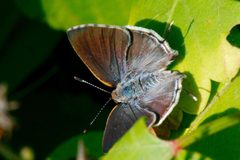
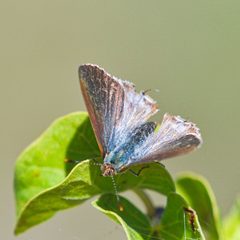
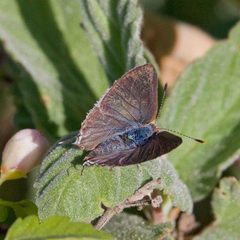
Small with wingspan 2.2–3.2 cm. Upperside: males dark iridescent purple; females grayish brown, sometimes with iridescent purple on wing bases. Underside: bright lime green in both sexes with prominent bright silvery-white postmedian band on both wings. Hindwing band forms a V-shape where it juts toward margin and turns back. Beyond this band, a dark brownish-red patch with variable silvery-white frosting extends across the hindwing edge. Hindwings bear one pair of tails.
Habitat
Subtropical woodlands, desert edges, and hammock margins. Presence strictly dependent on proximity to plants.
Distribution
North America (southern Florida, southern Texas, southern Arizona, occasional strays to southern California), Mexico, Central America, South America, and Baja California ( C. s. sarita).
Seasonality
Southern Florida: May–December. Southern Texas: June–December. Southern Arizona: March–June and October–mid-November. Occasional strays to southern California in October.
Diet
Larva feeds on unripe seeds inside plant seed pods. diet not documented.
Host Associations
- Cardiospermum halicacabum - larval balloon vine; laid on young fruits, larva feeds on unripe seeds inside seed pod
- Cardiospermum corindum - larval faux persil
- Eupatorium villosum - larval Florida Keys thoroughwort
Life Cycle
Female lays single shiny green on young fruits of plant. Larva is yellowish green to brownish with dark wavy and lines, dark greenish stripe edged with red ovals, and tan ; turns red before pupating. Chrysalis is tan to grayish brown with gray middorsal stripe, covered in black and brown spots, attached by silk pad and girdle. Two or three per year.
Behavior
occasionally stray northward beyond core range (documented in southern California).
Similar Taxa
- Chlorostrymon maesitesOnly similar in range; distinguished by smaller size, two pairs of hindwing tails, narrower or absent silver forewing band, and different upperside coloration in both sexes.
- Callophrys xamiRelated North American ; distinguished by much narrower silver-white postmedian line on underside of hindwing.
More Details
Subspecies
Chlorostrymon simaethis sarita occurs in Baja California and has been documented in studies there.