
Callophrys spinetorum
(Hewitson, 1867)
Thicket Hairstreak
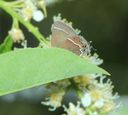
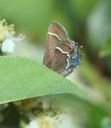
Callophrys spinetorum, the thicket , is a small in the Lycaenidae described by William Chapman Hewitson in 1867. It is distributed across western North America from British Columbia through the Rocky Mountains to New Mexico and Mexico, and through California to Baja California. The is a herbivore whose larvae feed exclusively on dwarf mistletoes in the Arceuthobium, exhibiting remarkable mimicry of their plants.

Pronunciation
How to pronounce Callophrys spinetorum: //kəˈlɒf.riːz ˌspaɪ.nɪˈtɔː.rəm//
These audio files are automatically generated. While they are not always 100% accurate, they are a good starting point.
Identification
Distinguished from similar hairstreaks by the combination of: short, broad wings; thin white post- line on hindwing underside; and association with coniferous forests containing dwarf mistletoe. The Juniper Hairstreak (Callophrys gryneus) has brighter green coloration and occurs in similar but lacks the distinct white line pattern. Other Callophrys typically show more pronounced tail projections or different underside markings.
Images
Appearance
Small with wingspan of 25–32 mm. Upper wing surfaces are gray-brown with orange marginal markings. Underside of hindwing features a thin, white post- line and a short tail-like projection on the hindwing margin. have relatively short, broad wings compared to other hairstreaks.
Habitat
Pinyon-juniper forests, mixed woodlands, and coniferous forests. Occurs in montane and foothill regions where plants (dwarf mistletoes) are present on conifer trees.
Distribution
Western North America: British Columbia south through the Rocky Mountains to New Mexico and Mexico; west through California to Baja California.
Seasonality
active from May to August. Single per year ().
Diet
Larvae feed exclusively on dwarf mistletoes ( Arceuthobium), specifically on shoots, flowers, and fruit. Documented include A. campylopodum, A. occidentale, A. abietinum, A. blumeri, A. cyanocarpum, A. laricis, A. vaginatum subsp. cryptopodum, A. divaricatum, and A. globosum. feed on flower nectar.
Host Associations
- Arceuthobium campylopodum - larval plantdwarf mistletoe
- Arceuthobium occidentale - larval plantdwarf mistletoe
- Arceuthobium abietinum - larval plantdwarf mistletoe
- Arceuthobium blumeri - larval plantdwarf mistletoe
- Arceuthobium cyanocarpum - larval plantdwarf mistletoe
- Arceuthobium laricis - larval plantdwarf mistletoe
- Arceuthobium vaginatum subsp. cryptopodum - larval plantdwarf mistletoe
- Arceuthobium divaricatum - larval plantdwarf mistletoe
- Arceuthobium globosum - larval plantdwarf mistletoe
Life Cycle
Single per year. laid on dwarf mistletoe plants. Larvae feed on shoots, flowers, and fruit of host, with body segmentation and coloration matching host plant tissue—an apparent case of mimicry. occurs in or near host plant. emerge May–August.
Behavior
Larvae exhibit mimicry of their plants, with segmented bodies and coloration matching the dwarf mistletoe tissue they consume. visit flowers for nectar.
Ecological Role
herbivore tightly linked to dwarf mistletoe . As a mistletoe feeder, larvae may influence mistletoe abundance and distribution, though population-level impacts have not been quantified. serve as when visiting flowers.
Human Relevance
No significant direct economic or agricultural impact. Of interest to lepidopterists and naturalists due to its specialized relationships and mimicry. for healthy dwarf mistletoe in western coniferous forests.
Similar Taxa
- Callophrys gryneusJuniper Hairstreak occurs in similar pinyon-juniper but has brighter green coloration above and lacks the thin white post- line on the hindwing underside; also has more slender wings
- Callophrys affinisWestern Green Hairstreak is brighter green above and has different underside patterning without the distinct white line
More Details
Subspecies
Two recognized: C. s. spinetorum (California, Colorado) and C. s. millerorum Clench, 1981 (New Mexico).
Taxonomic Note
Some authorities place this in the Mitoura based on morphological and molecular data; however, Callophrys is widely used in North American literature.