
Arawacus
Kaye, 1904
stripe-streaks, stripestreaks
Species Guides
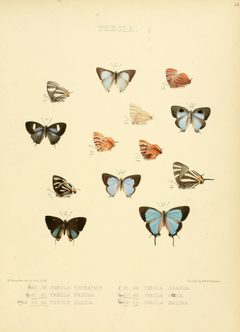
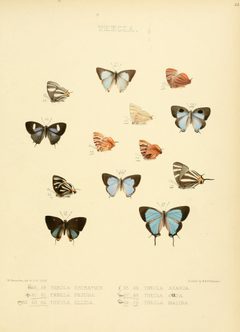
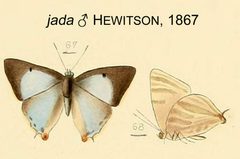
1- Arawacus jada(creamy stripe-streak)
Arawacus is a of gossamer-wing butterflies in the Lycaenidae, commonly known as stripe-streaks. The genus contains approximately 17 described distributed throughout the , from Mexico south through Central America to Brazil, Peru, and Argentina. Members of this genus are notable for their distinctive false- defensive on the hindwings, which helps misdirect attacks away from vital body parts.
Pronunciation
How to pronounce Arawacus: /ˌærəˈweɪkəs/
These audio files are automatically generated. While they are not always 100% accurate, they are a good starting point.
Identification
Arawacus can be distinguished from similar lycaenid by their characteristic false- : -like filaments (tails) at the hindwing tips, dark rounded patches resembling a head, and often a white eyespot. These features combine to create a visual deception that directs attention to the rear of the . Converging dark wing bands further draw attention toward the false head rather than the actual head at the end. The "stripe-streaks" refers to linear markings present on many species.
Images
Habitat
Tropical and subtropical forest , including rainforest understory and forest edge environments. have been observed feeding on leaves and lapping fluids from vegetation in low vegetation layers.
Distribution
: Mexico, Central America ( Rica, Panama, Belize), and South America (Colombia, Venezuela, Trinidad, Suriname, Bolivia, Peru, Paraguay, Argentina, Brazil). Specific show varying geographic ranges, with some restricted to particular regions (e.g., Arawacus aethesa in Bahia, Brazil; Arawacus hypocrita ranging from Mexico to Costa Rica).
Behavior
have been observed lapping food from leaves. The exhibits a distinctive defensive : slow, rhythmic waggling of the -like hindwing filaments to enhance the false- deception. When perched, individuals orient themselves to present the false head toward potential threats, increasing the likelihood that a will strike at the expendable wing tips rather than vital head, , or structures.
Ecological Role
may contribute to pollination through feeding activities. Their false- defense represents an evolutionary response to pressure from visually hunting such as birds and lizards.
Similar Taxa
- Other Theclinae (hairstreaks)Many lycaenid butterflies, particularly hairstreaks in Theclinae, possess similar tail-like hindwing extensions. Arawacus is distinguished by the specific combination of -like filaments, dark -mimicking patches, and white eyespots forming a cohesive false-head illusion, along with converging wing band patterns that direct attention posteriorly.
- Other Lycaenidae genera with false headsSeveral lycaenid have independently evolved false- defenses. Arawacus are differentiated by their Neotropical distribution, specific stripe-streak wing patterns, and the particular arrangement of false-head elements (filament position, eyespot placement, and dark patch configuration).
More Details
Etymology
The name Arawacus was established by William P. Kaye in 1904. The origin of the name is not definitively documented in available sources.
Species diversity
The includes approximately 17 described , with Arawacus aetolus, Arawacus jada (creamy stripe-streak, nightshade hairstreak), and Arawacus sito (fine-lined stripe-streak) among the more widely distributed. Several species have restricted ranges in specific Brazilian states or Andean regions.
Defensive evolution
The false- defense in Arawacus exemplifies with other lycaenid lineages. This is particularly effective against that direct strikes at the body region to disable prey quickly; by redirecting attacks to wing margins, butterflies sacrifice replaceable wing tissue while preserving critical structures and escaping.