
Allosmaitia strophius
(Godart, 1824)
Strophius Hairstreak
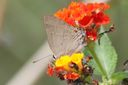
Allosmaitia strophius, the Strophius , is a small Neotropical hairstreak in the Lycaenidae. It ranges from southern Brazil northward through Central America to Sinaloa, Mexico, with occasional strays reaching Texas. are active year-round in Central America, with Texas records limited to November. The has a wingspan of 22–32 mm.
Pronunciation
How to pronounce Allosmaitia strophius: /ˌæl.oʊˈsmaɪtiə ˈstroʊ.fi.əs/
These audio files are automatically generated. While they are not always 100% accurate, they are a good starting point.
Identification
Distinguished from other hairstreaks by geographic range combined with size; 22–32 mm wingspan is relatively small. The combination of Neotropical distribution (southern Brazil to Mexico) with specific Malpighia flower-feeding larvae separates it from North American Theclinae. Similar Allosmaitia require genitalic or wing pattern examination for definitive identification.
Images
Appearance
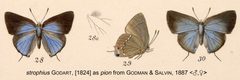
Small with wingspan 22–32 mm. As a , possesses thin tail-like projections on the hindwings. Upper wing surfaces typically show blue or iridescent coloration common to the . Underside patterning and precise coloration details require direct examination of specimens.
Habitat
Occupies tropical and subtropical regions from southern Brazil through Central America to northwestern Mexico. Specific microhabitat preferences are not well documented but likely include forest edges and areas where plants occur.
Distribution
Native range: southern Brazil north to Sinaloa, Mexico. Strays documented as far north as Texas, USA. Distribution follows plant availability (Malpighia ).
Seasonality
active year-round in Central America. In Texas, strays have been recorded in November only. No seasonal data available for southern portions of range.
Diet
Larvae feed on flowers of Malpighia ( Malpighiaceae). feeding habits are not documented.
Host Associations
- Malpighia - larval food plantflowers specifically
Life Cycle
Complete with , larva, pupa, and stages. Specific developmental timing and strategy are not documented.
Behavior
Typical including perching with wings closed and hindwing tails oriented to deflect attacks. Detailed behavioral observations are limited.
Ecological Role
Larval herbivore on Malpighia flowers; potential as . Specific functions are not well studied.
Human Relevance
Minor significance as occasional stray to southern Texas; of interest to lepidopterists documenting range extensions. Not known to be of economic importance.
Similar Taxa
- Other Allosmaitia speciesSimilar size and ; require detailed examination for separation
- Other Theclinae hairstreaks in overlapping rangeShare tail-like hindwing projections; identification requires attention to size, coloration, and geographic origin
More Details
Taxonomic history
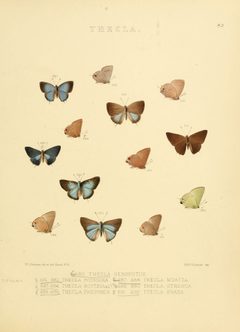
Originally described as Polyommatus strophius by Godart in 1824. Later transferred to Thecla, then to Allosmaitia. GBIF lists Thecla strophius as a synonym.
Observation frequency
iNaturalist records 322 observations, indicating moderate documentation but not exceptional abundance.